

Holly (Ilex aquifolium): planting, berries, pruning and care

To grow holly successfully, plant it in autumn or spring, in sun or partial shade, in soil that is neither waterlogged nor very dry, and pair a female plant with a male if you want berries.
Common holly, Ilex aquifolium, is one of the few evergreen shrubs native to France: leathery, glossy leaves, slow growth, and red berries that have adorned winter since ancient times. This guide answers the real questions: why a holly has no berries, shade or sun, holly in a pot, pruning, defensive hedging, toxicity, and Christmas tradition.
If you’re looking for a boxwood lookalike for an edging, read our guide to crenate holly, an alternative to boxwood. Every fact comes from Kew, the RHS (Royal Horticultural Society), NC State, the ASPCA, or American universities.
🌿 Male and female holly: why only female plants bear berries
A holly without berries is almost always a male plant or an isolated female. According to the RHS Ilex aquifolium profile, male and female flowers generally grow on separate plants, and only female plants produce fruit.
According to the RHS guide to growing hollies, a female needs a male nearby, and one male can pollinate several females within a radius of 20 to 50 m. A few cultivars are exceptions, such as the self-fertile Ilex aquifolium 'J.C. van Tol'.
Finally, beware of the names: the RHS notes that 'Golden King' is female and 'Silver Queen' male. The small, white, fragrant flowers open from May to June and attract bees, notes NC State Extension (North Carolina State University).
| Benefit | What it means for you |
|---|---|
| A native evergreen | Dark green, glossy foliage all year, at home in France (POWO) |
| Berries in the depths of winter | Ripening from late summer to autumn, they often last into winter and attract birds (NC State) |
| An impenetrable hedge | Its spiny leaves make it a medium- to large-sized defensive hedge (RHS) |
| Undemanding | Any well-drained soil, sun or shade, slow-growing and easy to keep in check (RHS) |
🔎 Holly at a glance
According to Plants of the World Online (POWO), the database of the Royal Botanic Gardens, Kew, the accepted name is Ilex aquifolium L., published by Linnaeus in 1753; it is a shrub or tree of temperate regions.
Its natural range covers Europe and northwestern Africa, including France and Corsica, Spain, Portugal, Italy, Great Britain, Ireland, Germany, Switzerland, Algeria, Morocco, and Tunisia, among others.
Kew also lists it as introduced, notably in North America, Australia, and New Zealand. NC State notes that it has become naturalized in the northwestern United States, where it appears on invasive species lists—a concern that does not apply to France, where it is native.
The RHS describes it as a large shrub or tree, growing to over 12 m tall and 4 to 8 m wide in 20 to 50 years.
| Feature | Verified details |
|---|---|
| 🏷️ Botanical name | Ilex aquifolium L. (POWO); common holly, European holly |
| 🧬 Family | Aquifoliaceae, the holly family |
| 🌳 Type | Evergreen shrub or small tree, dioecious, slow-growing |
| 🌍 Origin | Europe, including France and Corsica, and northwestern Africa (POWO) |
| ❄️ Hardiness | H6, from -20 to -15 °C (RHS) |
| 🍃 Foliage | Evergreen, dark green, glossy, generally very spiny (RHS) |
| 🌸 Flowering | Small, fragrant white flowers from May to June; red berries about 6 mm across on female plants (NC State) |
| 📏 Mature size | Over 12 m tall and 4 to 8 m wide in 20 to 50 years (RHS); easy to keep in check with pruning |
📋 Quick growing guide
Essential growing details, all at a glance.
| Factor | Guideline |
|---|---|
| Position | Sun or partial shade; full shade for green-leaved hollies, sun for variegated varieties (RHS) |
| Soil | Chalk, clay, loam, or sand, acidic to alkaline, moist but well-drained (RHS) |
| Hardiness | H6, from -20 to -15 °C (RHS); shelter from cold winter winds (NC State) |
| Watering | Water when the soil feels dry, especially in the first year and in pots; never let the soil become waterlogged |
| Planting | Autumn or spring; also in winter if the soil is neither frozen nor waterlogged (RHS) |
| Pruning | Mid- to late summer for a specimen plant, late summer for a hedge (RHS) |
| Fruiting | Red berries from late summer to autumn, persisting into winter, on female plants (NC State) |
| Care | Easy; watch for holly leaf miner, holly leaf blight, and excess water |
| Toxicity | Toxic to dogs, cats, and horses; low toxicity (ASPCA); gloves recommended (RHS) |
📍 Where and when to plant holly: shade or sun?
Holly grows in sun or shade, but berries and variegated foliage need light. The RHS recommends full sun or partial shade, allows full shade for hollies with plain green foliage, and advises choosing a sunny spot for variegated varieties to preserve their color.
Just avoid spots that stay waterlogged or become very dry in summer. In soil that remains wet, the RHS suggests planting on a mound 25 to 30 cm high and about 1 m in diameter. NC State adds that holly appreciates shelter from cold winter winds.
As for timing, autumn and spring are the best seasons, when the soil is moist and still warm; however, container-grown holly can be planted year-round. As it will eventually become a tree, also respect the planting distances from your neighbor's property.
☀️ Ideal: Sun or partial shade, moist, well-drained soil, sheltered from cold winds; full sun for variegated varieties
🗓️ When: Autumn and spring; year-round for container-grown holly, except when the ground is frozen or waterlogged (RHS)
🚫 Avoid: Waterlogged hollows, soil that dries out in summer, and the edges of play areas because of the berries and spines
🪴 Planting holly in the ground or in a pot
Holly is planted like most shrubs, but it cannot tolerate standing water.
Our two hollies, the standard-form 'Blue Maid' holly in a 19 cm pot and the 'Blue' holly, sold in a set of eight 9 cm pots for a hedge, are 'Blue Maid' cultivars of Ilex × meserveae, a hybrid created in the United States by Mrs. Meserve by crossing Ilex rugosa with Ilex aquifolium or Ilex cornuta, according to the University of Connecticut.
According to the RHS profile, 'Blue Maid' is a female with spiny, blue-green leaves and abundant red berries. Rated H7 (below -20 °C), it reaches 2.5 to 4 m tall and 1.5 to 2.5 m wide in 10 to 20 years. The University of Connecticut recommends 'Blue Prince', a male, to pollinate Meserve hollies.
For container growing, the RHS recommends a pot about 5 cm wider all around than the previous one, a mix of peat-free potting compost and John Innes-type compost, and repotting in spring every 2 to 3 years.
| Step | What to do |
|---|---|
| 1. Choose the time | Autumn or spring, with moist, warm soil; never when the soil is frozen or waterlogged (RHS) |
| 2. Prepare the soil | Loosen a wide area; in soil that stays wet, plant on a 25 to 30 cm mound (RHS) |
| 3. Set the root ball | Moisten the root ball thoroughly and set the root collar level with the soil, without burying it deeper |
| 4. Backfill and water | Firm gently, water thoroughly, then check by touch during the first few months |
| 5. In a pot | Choose a pot 5 cm wider all around, with drainage holes; repot every 2 to 3 years in spring (RHS) |
columns: 4
columns_mobile: 2
-
'Blue Maid' Holly (Ilex) - evergreen hedging shrub - 19 cm pot - Height 90 cm
Regular price 74,95 €Regular price -

 Livraison offerte Sold out
Blue Holly (Ilex), evergreen hedging plant, 9 cm pot, Height 25-30 cm - Pack of 8
Regular price 59,95 €Regular price -

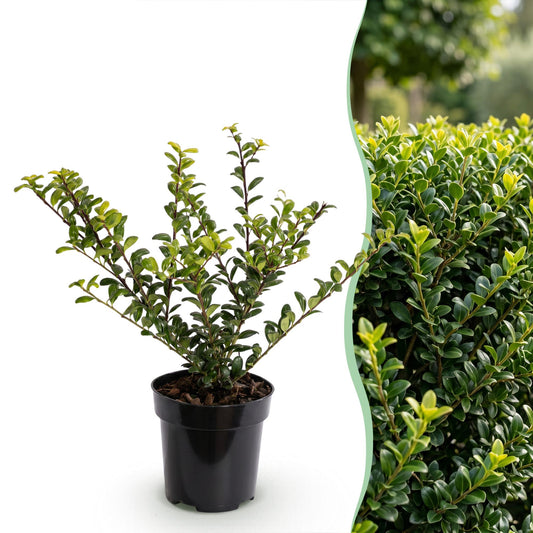
Golden Gem Japanese Holly (Ilex crenata), evergreen hedging plant, 9 cm pot, Height 20-30 cm
Regular price From 59,95 €Regular price -

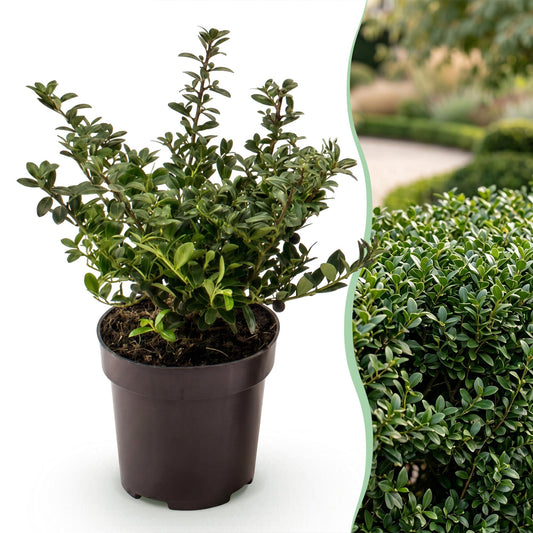
Stokes' Crenate Holly (Ilex crenata), evergreen hedging plant, 9 cm pot, Height 20-30 cm
Regular price From 59,95 €Regular price -


Japanese Skimmia 'Festival' (Skimmia japonica) – evergreen red and white flowering plant – 15 cm pot – Height 30 cm
Regular price 44,95 €Regular price -


Japanese skimmias in white and red pairs (Skimmia japonica) – evergreen shade shrubs
Regular price From 44,95 €Regular price


✂️ Holly care and pruning: watering, hedging, and rejuvenation
Once established, holly mainly needs water during its first year and pruning at the right time. Water when the soil feels dry a few centimeters down, and never leave the plant standing in water: the RHS notes that waterlogged soil damages the roots and causes dieback. Holly grows slowly and is easy to keep in check, the RHS points out.
The RHS recommends pruning a specimen plant in mid- to late summer, keeping a central leader, and trimming a hedge in late summer, since earlier pruning leads to uneven regrowth. To rejuvenate an old holly, prune in spring, removing no more than a third each year, and spread heavy pruning over 2 to 3 years.
Wear gloves: the RHS recommends them when handling the plant.
💧 Watering: Water when the soil feels dry; regularly during the first year and for container-grown plants, then only during dry spells
✂️ Pruning: Specimen plant: mid- to late summer; hedge: late summer (RHS)
🔹 Rejuvenation: In spring, no more than a third each year, over 2 to 3 years (RHS)
🔹 Variegated varieties: Remove shoots that have reverted to entirely green (RHS)
🍂 Mulch: Apply bark or leaves around the base to retain moisture, without touching the trunk
🍂 Holly at Christmas and throughout the seasons
Holly has adorned Christmas for far longer than Christmas itself: according to Duke University Gardens, the Romans already decorated their homes with holly during Saturnalia for good luck, and in Europe, where Ilex aquifolium is the only native holly, it was planted near homes to ward off evil spirits.
That is the origin of its symbolism of protection and good fortune—a tradition rather than a botanical fact. For your decorations, cut a few sprigs from a holly in your garden rather than from a wild plant: NC State notes that its berries, which persist through winter, are highly sought after by birds.
In spring, the subtle flowering sets the berries in motion; it is also when the RHS considers a small drop of old leaves after a cold winter to be normal. In summer, water young plants and prune; in autumn, plant.
📅 Seasonal care calendar
| Season | Key task |
|---|---|
| 🌸 Spring | Flowers from May to June (NC State); plant, rejuvenate old plants, and repot container-grown hollies every 2 to 3 years (RHS) |
| ☀️ Summer | Check soil moisture by touch for young hollies; prune specimen plants and hedges in late summer (RHS) |
| 🍂 Autumn | Ideal planting season; berries ripen from late summer to autumn (NC State); refresh mulch |
| ❄️ Winter | Decorative berries provide food for birds; cut sprigs for Christmas; plant if the ground is not frozen (RHS) |
🌱 How do you propagate holly?
Holly can be propagated by seed, cuttings, or, for named varieties, vegetatively. The RHS lists three methods: sowing in a cold frame in autumn, taking semi-ripe cuttings from late summer to early autumn, or taking hardwood cuttings in January with bottom heat.
Seedlings do not come true to variety or parent sex, and you will not know whether a young plant is male or female until it flowers for the first time, several years later. So if you want a female that is sure to bear berries, it is best to take a cutting from a known female or choose a variety identified as 'Blue Maid'.
🐛 Holly problems: leaf miner, falling leaves, no berries
Holly is hardy; most problems stem from soil that is too wet, a male plant, or a relatively harmless insect.
According to the RHS profile of holly leaf miner, the holly leaf miner, Phytomyza ilicis, is a small fly whose larva tunnels through leaves. It produces one generation a year, laying eggs on young leaves in May and June; the larva pupates in its mine the following spring.
The blemishes it leaves have little effect on growth; the RHS advises tolerating it, as parasitoid wasps and blue tits feed on the larvae. The RHS also lists holly leaf blight, which causes leaf drop, scale insects, aphids on young shoots, Phytophthora root rot, and, occasionally, honey fungus.
| Symptom | Likely cause | Solution |
|---|---|---|
| Yellowish-white or purplish spots on older leaves | ⚠️ Holly leaf miner, Phytomyza ilicis (RHS) | Tolerate it; on a small plant, remove affected leaves without stripping it bare |
| No berries | ♀️ Male plant, or female without a male within 20 to 50 m (RHS) | Plant a male nearby, or choose a self-fertile cultivar such as 'J.C. van Tol' |
| A few leaves drop in spring, especially after a cold winter | ⚠️ Common in evergreen hollies (RHS) | No treatment needed |
| Premature leaf drop, bare branches | ☀️ Holly leaf blight (RHS) | Collect fallen leaves, improve airflow, and avoid stagnant moisture |
| Black deposits on leaves | 🍄 Sooty mold, a sign of scale insects (RHS) | Clean affected branches and encourage beneficial insects |
| Weak growth, branches drying out | 💧 Waterlogged soil and damaged roots (RHS) | Improve drainage or replant on a mound |
-

Outdoor plants that keep their foliage all year round: evergreen privacy hedges,...


🌸 Holly varieties: variegated, blue and self-fertile holly
Hollies are distinguished by their foliage, which may be green, bluish or variegated, and by their sex, indicated by (f) or (m) in RHS plant profiles. Sources: RHS, NC State and the RHS selection of award-winning hollies; mature sizes. Variegated hollies need full sun to retain their colour.
| Variety | What makes it special |
|---|---|
| Ilex aquifolium, common holly | The wild species, with dark green, spiny leaves, eventually reaching over 12 m (RHS); ideal for a defensive hedge |
| Ilex × meserveae 'Blue Maid' (f) | Female blue holly, H7, 2.5 to 4 m (RHS); our 'Blue Maid' holly on a standard stem in a 19 cm pot and our hedge bundles |
| Ilex aquifolium 'Argentea Marginata' (f) | Variegated holly with creamy white margins, pink-red young shoots and red berries; 12 m or more, excellent as a hedge or topiary (RHS) |
| Ilex aquifolium 'J.C. van Tol' (f) | Self-fertile female that bears berries without a male (RHS) |
| Ilex × altaclerensis 'Golden King' (f) | Yellow-variegated, almost spineless, 3 m; a female despite its name (RHS) |
| Ilex aquifolium 'Silver Queen' (m) | Silver-variegated, a male despite its name: no berries, but a good pollinator (RHS) |
🎨 Defensive hedges and planting combinations: where to plant holly
Common holly makes a defensive hedge: the RHS recommends it for an impenetrable, medium-to-large hedge, thanks to its spiny leaves. To plan yours, follow our guide to creating a privacy hedge, and, if possible, mix a male plant with the females to produce berries.
For a winter container display, holly pairs well with a 'Festival' skimmia or a white and red skimmia duo, other winter-berry shrubs described in our Japanese skimmia guide, and with ideas from our winter planter guide.
For a low, spineless border, choose a 'Golden Gem' Japanese holly—a very different kind of holly.
Holly also belongs among our frost-hardy outdoor plants, in the seasonal tasks in our guide to what to do in the garden in winter, and among the Christmas plants to give as gifts.
Browse our Ilex hollies and other evergreen shrubs, our frost-hardy plants and our hedge and screening plants.
⚠️ Are holly berries toxic to children and pets?
Yes, holly berries are toxic and should not be eaten.
For common holly, Ilex aquifolium, the ASPCA (American Society for the Prevention of Cruelty to Animals) “European Holly” profile states “Toxic to Dogs, Toxic to Cats, Toxic to Horses”: the plant is toxic to dogs, cats and horses because of its saponins, and causes vomiting, diarrhoea and lethargy; the ASPCA notes that the leaves and berries are of low toxicity.
NC State adds that the fruit, the toxic part, is particularly dangerous to children. The RHS classifies the plant as potentially harmful and advises wearing gloves and keeping pets away from the fruit. If ingested, contact a poison control centre or your veterinarian.
✅ Our expert tips for success
Holly thrives when you make three choices right from the start: choose a female plant for berries, have a male nearby, and provide soil that does not stay waterlogged. Plant in autumn or spring, in sun or partial shade, water when the soil feels dry during the first year, and prune in late summer.
Tolerate leaf miner damage, keep berries out of reach of children and pets, and cut your Christmas branches from your own garden. For a low, box-like border, choose Japanese holly.
Holly is the shrub I most often recommend for a difficult spot, in the shade of a wall or beneath large trees: it needs almost no attention. The question I hear every winter is always the same: “Why doesn't my holly have berries?” I tell people to check the label before looking at the sky: without a female, and a male not too far away, there will never be any berries.

Laura Bruneau
Jardinière & autrice


