Dwarf Palm (Chamaerops humilis): Planting and Care

To successfully grow a dwarf palm, plant it in spring in full sun, in very well-drained soil, water it regularly the first year, then leave it to fend for itself: once established, it tolerates drought, heat, and salt spray. The Mediterranean dwarf palm, Chamaerops humilis, also known as doum, is one of the most cold-hardy palms according to NC State Extension.
Important note: this guide does not cover the Florida dwarf palm (Serenoa repens) or the Chamaedorea elegans sold as an indoor dwarf palm. Here you will find verified hardiness ratings for each variety, planting, container growing, and overwintering.
🌿 Why plant a dwarf palm in the garden
Its name says it all: Chamaerops comes from the Greek "ground-hugging shrub" and humilis means "low", as noted by NC State Extension.
Where a large palm grows on a single trunk, the dwarf palm forms a bushy clump of several short trunks, ideal for a dry bed, rock garden, or large patio container.
It is also the smallest of our hardy palms: the hemp palm (Trachycarpus fortunei) grows taller and tolerates more cold, while the Washingtonia requires a milder climate.
Three forms are commonly found in garden centers. 'Vulcano' is a compact form with blue-green fronds, silver on the underside, rated H4 like the type. 'Cerifera' has blue-silver fronds but is only rated H3 (-5 to 1 °C), as is 'Compacta', a compact, slow-growing form.
| Key feature | What it means for you |
|---|---|
| Mediterranean palm hardiness | A real palm that spends the winter outdoors in mild-winter regions, without a greenhouse |
| Compact clumping habit | 1.5 to 2.5 m according to the RHS: it fits into a small garden or container |
| Water-efficient | Once established, it tolerates drought, heat, and salt spray (NC State) |
| Wind resistance | The RHS describes it as wind-resistant, an asset by the sea |
🔎 The dwarf palm's ID card
According to Plants of the World Online (POWO) from the Royal Botanic Gardens, Kew, Chamaerops humilis L., published by Linnaeus in 1753, is an accepted species in the Arecaceae family (palms).
Its native range covers Algeria, the Balearic Islands, Spain, France, Italy, Libya, Morocco, Portugal, Sardinia, Sicily, and Tunisia; POWO lists it as introduced to Corsica, the Azores, and the Dominican Republic.
According to the RHS (Royal Horticultural Society), it reaches 1.5 to 2.5 m high and 1 to 1.5 m wide, but takes 20 to 50 years: it is a very slow-growing palm.
Its fronds measure up to 45 cm according to the RHS; the North Carolina State University Extension (NC State Extension) describes petioles armed with many sharp spines.
| Criterion | Verified detail |
|---|---|
| 🏷️ Botanical name | Chamaerops humilis L. (Mediterranean dwarf palm, doum) |
| 🧬 Family | Arecaceae (Arecaceae), the palm family |
| 🌳 Type | Evergreen bushy palm, in a clump of several short trunks |
| 🌍 Origin | Western and central Mediterranean, Europe and North Africa, including France (POWO) |
| ❄️ Hardiness | H4 according to the RHS, i.e., around -10 to -5 °C; 'Cerifera' and 'Compacta' H3 (-5 to 1 °C) |
| 🍃 Foliage | Fan-shaped fronds with 10 to 20 leaflets, spiny petioles (NC State) |
| 🌸 Flowering | Small yellow flowers in spring between the fronds, then fruit (NC State) |
| 📏 Adult size | 1.5 to 2.5 m high, 1 to 1.5 m wide in 20 to 50 years (RHS) |
📋 Quick technical sheet
Essential growing guidelines, all at a glance.
| Parameter | Guideline |
|---|---|
| Exposure | Full sun (6 hours or more) or partial shade (2 to 6 hours of direct sun) according to NC State |
| Soil | Perfectly drained; tolerates poor and dry soil, 'Vulcano' accepts lime (RHS) |
| Hardiness | H4 (RHS), around -10 to -5 °C; blue and compact forms H3 |
| Watering | Regularly the 1st year, then occasionally in summer; in a container, moderate during growth |
| Planting | In mid-spring, so that it establishes before winter (RHS) |
| Pruning | None required (RHS): remove dry fronds, without cutting flush with the trunk |
| Foliage | Evergreen, fan-shaped, green to blue-silver depending on the form |
| Maintenance | Easy, slow growth; monthly fertilizer in a container in spring and summer |
| Toxicity | No ASPCA sheet; very spiny petioles, gloves essential |
📍 Where and when to plant a dwarf palm?
Plant your dwarf palm in mid-spring, the period the RHS recommends for hardy palms to establish roots before winter. Choose the sunniest spot: NC State Extension accepts full sun (6 hours or more) or partial shade (2 to 6 hours), but notes that it loses its compact habit if it lacks light.
The real criterion is drainage: on waterlogged clay soil in winter, the RHS advises planting on a mound of about 25 cm. A south-facing position at the foot of a wall, sheltered from cold winds, remains the ideal location in border regions.
☀️ Ideal: Full south, stony or sandy soil, well-drained position at the foot of a wall or on a bank
🌥️ Acceptable: Bright partial shade or clay soil, provided it is planted on a mound
🚫 Avoid: Damp hollows, dense shade, waterlogged soil in winter
🪴 Planting a dwarf palm in the ground or in a container
In the ground, the dwarf palm adapts to various soils as long as water drains away: the RHS indicates that the RHS 'Vulcano' sheet tolerates poor and dry, chalky, loamy, or sandy soil. NC State Extension requires well-drained soil with a pH of 6.0 to 8.0.
In a container, the RHS guide to hardy palms recommends a soil mix based on soil and free of peat, such as John Innes No. 3, and container protection in winter. Choose a heavy and perforated container: the clump takes up volume, and a container that is too light will tip over in the wind.
| Step | The right approach |
|---|---|
| 1. Choose the period | Mid-spring, when the soil is dry and warmed |
| 2. Prepare the hole | Significantly wider than the root ball; on clay, build a mound of about 25 cm (RHS) |
| 3. Lighten the soil | Mix the soil with gravel or sand to ensure drainage |
| 4. Install the root ball | At the same level as in the container, without burying the heart of the clump |
| 5. Water and mulch | Water copiously, then apply mineral mulch that does not retain moisture at the base |
columns: 4
columns_mobile: 2
-

 Livraison offerte
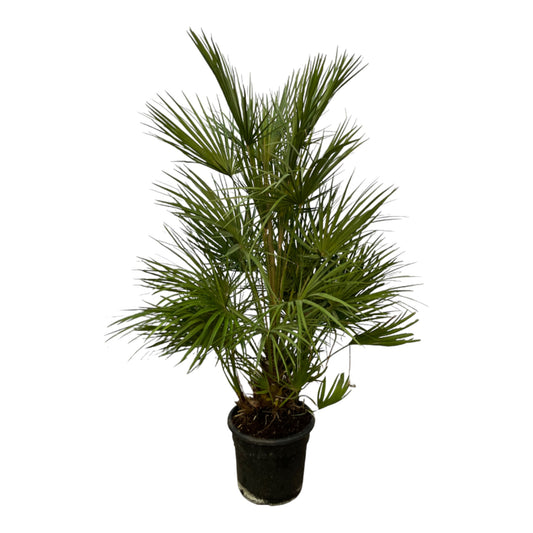
Mediterranean dwarf palm (Chamaerops humilis) - evergreen palm
Regular price From 49,95 €Regular price -

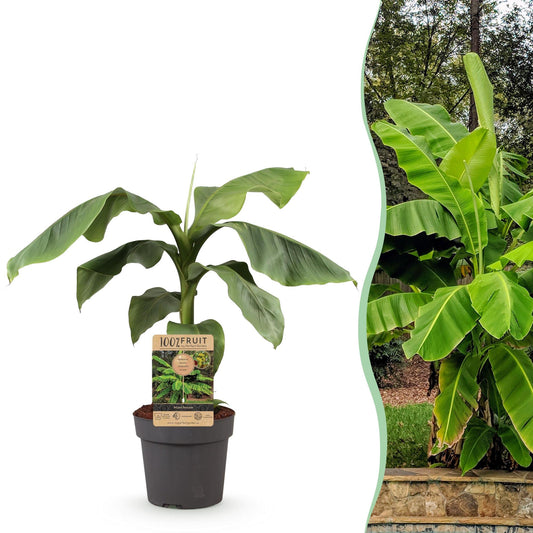
Hardy banana plant (Musa basjoo) - hardy banana plant with exotic green foliage - 21 cm pot - Height 90 cm
Regular price 59,95 €Regular price -


Rosemary (Rosmarinus officinalis), Mediterranean perennial, purple flowers, 19 cm pot, Height 90 cm
Regular price 69,95 €Regular price


✂️ Dwarf palm care: watering, fertilizer, and pruning
The maintenance of a dwarf palm established in the ground is minimal: NC State Extension states that once established, it resists drought and heat. The first year, water regularly as soon as the soil dries on the surface, then space out watering.
In a container, the water reserve is limited: the RHS advises moderate watering during growth and monthly fertilizer, then less water in winter. Regarding pruning, the RHS indicates that no pruning is necessary; simply remove dry fronds, without cutting them flush with the trunk, states its hardy palms guide.
💧 Watering in the ground: Regularly the 1st year, then only during long summer droughts
💧 Watering in a container: Moderately in spring and summer, when the substrate has dried on the surface; reduced in winter
🌱 Fertilizer: In a container, balanced fertilizer once a month in spring and summer (RHS)
✂️ Pruning: Cut dry fronds close to their base, leaving a short stub, never flush with the trunk (RHS), with gloves and clean secateurs
🔹 Offshoots: Keep for a clump, remove to obtain a single trunk (NC State)
🍂 Dwarf palm hardiness and overwintering
Is the dwarf palm afraid of frost? Moderately: its RHS sheet rates it H4, i.e., around -10 to -5 °C, and the RHS hardy palms guide states that it tolerates -12 °C or less. NC State Extension places it in USDA zones 8a to 11b, with zone 8a corresponding to minimums of around -12 to -9 °C.
Be careful with blue and compact forms: 'Cerifera' and 'Compacta' are rated H3 (-5 to 1 °C). For comparison, the hemp palm is rated H5 and resists -15 °C or less if sheltered according to the RHS. In a container, the roots are more exposed: the RHS advises wrapping the container in bubble wrap or jute cloth in winter.
📅 Seasonal maintenance calendar
| Season | Key action |
|---|---|
| 🌸 Spring | Planting in mid-spring, resuming watering and monthly fertilizer in a container, removing fronds damaged by winter |
| ☀️ Summer | Full sun, occasional watering in the ground during droughts, regular in a container; yellow flowering between the fronds |
| 🍂 Autumn | Stop fertilizer, reduced watering, preparing container protection |
| ❄️ Winter | Wrapped and elevated container, rare watering, winter fleece during severe cold for H3 forms |
🌱 Propagating the dwarf palm: offshoots and sowing
The simplest method is the division of offshoots: the RHS cites propagation by sowing or by cuttings, and NC State Extension by division and by sowing.
In spring, clear an offshoot already equipped with roots at the foot of the clump, separate it with a clean spade while keeping as many roots as possible, then repot it in a well-drained mix, in light, watering moderately. Sowing is possible but very slow, given the growth of the dwarf palm: expect years before obtaining a decorative clump. Wear thick gloves: spiny petioles wound easily.
🐛 Common problems: causes and solutions
The main cause of dwarf palm failure is excess water: NC State Extension notes that overwatering causes root and trunk rot. Regarding pests, the RHS cites the spider mite, thrips and scale insects, especially under cover, and more rarely the mealybug; NC State Extension adds powdery mildew indoors.
For cold damage, our guide to protecting your plants from frost details the fleece and mulching.
| Symptom | Probable cause | Solution |
|---|---|---|
| Heart browning and easily pulled out, soft base | 🍄 Rot due to waterlogged soil or a container without drainage | Remove soft parts, stop watering, replant on a mound or in a well-drained mix |
| Yellowing fronds in winter in a container | ❄️ Roots exposed to wet cold | Wrap the container, elevate it, and limit watering |
| Brown or scorched fronds after a cold snap | ❄️ Frost below the hardiness threshold of the cultivated form | Wait for spring, cut dead fronds, protect the following winter |
| Fine webs, speckled and dull fronds | 🕷️ Spider mites (mites), favored by dry air under cover | Shower the foliage, ventilate, take the plant out into the open air |
| Small brown shields or cottony clusters | 🐛 Scale insects | Remove with cotton soaked in alcohol, treat if the infestation persists |
| Sparse clump that stretches out | ☀️ Lack of light | Move to full sun, remove dead fronds |
-

Banana plants, ensetes and exotic plants for a lush garden — hardiness...


🌿 Our selection to go further
Our guides to creating an exotic or Mediterranean corner around the dwarf palm, and our collections to complete the scene.
| Our selection | Why choose it |
|---|---|
| Palmier chanvre | The most hardy palm in our guides, rated H5: the right choice if your winters exceed the dwarf palm's tolerance threshold |
| Washingtonia (palmier jupon) | The palm with a large trunk and fan-shaped fronds, for gardens with mild winters |
| Aménager un jardin méditerranéen | The cornerstone for creating a dry bed with olive trees, lavender, and palms |
| Plantes méditerranéennes | Our collection of sun- and drought-loving plants, to pair with a dwarf palm |
| Palmiers d'intérieur | For bringing a palm into the house: the species made for indoors |
🎨 What plants to pair with the dwarf palm
The dwarf palm naturally finds its place in a Mediterranean garden: its fan-shaped clump contrasts with the silvery foliage of an olive tree, the flowering of the lavenders or the bushy habit of the rosemary.
In a dry garden, it provides a graphic silhouette all year round alongside grasses.
For an exotic setting, pair it with other hardy exotic plants such as the Japanese banana tree, or discover our exotic banana trees and our plants for balconies and terraces.
Our Mediterranean plant guide and the outdoor plant collection complete the selection.
⚠️ Is the dwarf palm toxic or dangerous?
We found no ASPCA (American Society for the Prevention of Cruelty to Animals) fact sheet dedicated to Chamaerops humilis, and neither the RHS nor NC State Extension lists it as toxic: we cannot therefore state that it is toxic, nor guarantee that it is safe for animals.
The proven risk is mechanical: NC State Extension describes petioles armed with numerous sharp, needle-like spines. Plant it away from walkways and children's play areas, and wear gloves during any maintenance.
Finally, research on "dwarf palm" as a dietary supplement concerns another plant, Serenoa repens, a palm from the southeastern United States: this fact sheet does not cover it.
✅ Our expert tips for success
A successful dwarf palm depends on three rules: sun, soil that never retains water, and a form suited to your winters. Choose the 'Vulcano' type (H4) where winter temperatures remain above around -10 °C, and reserve 'Cerifera' and 'Compacta' (H3) for mild climates or sheltered containers.
Plant in spring, water during the first year, then let it grow at its own slow pace: it will reward you for decades. If your winters are colder, turn to the hemp palm.
The dwarf palm is the palm I recommend for a small garden or a sunny terrace: it stays at a manageable size and requires almost nothing. The only mistake I really see is overwatering, especially in a pot during winter. I always keep a pair of thick gloves nearby when cleaning a clump: its petioles are unforgiving. And I like to let the offshoots develop, for the bushy habit that gives it all its charm.

Laura Bruneau
Jardinière & autrice