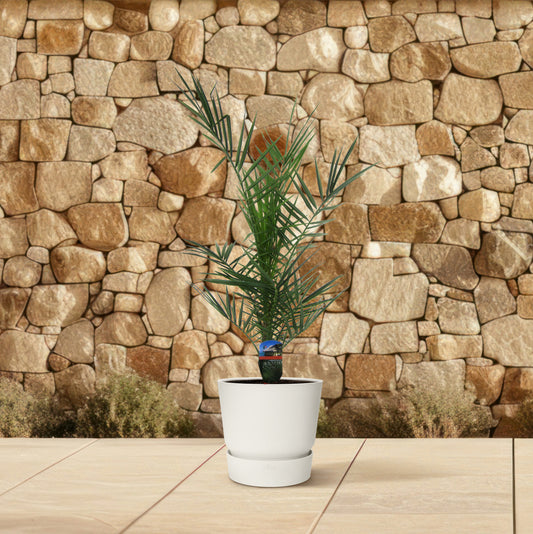
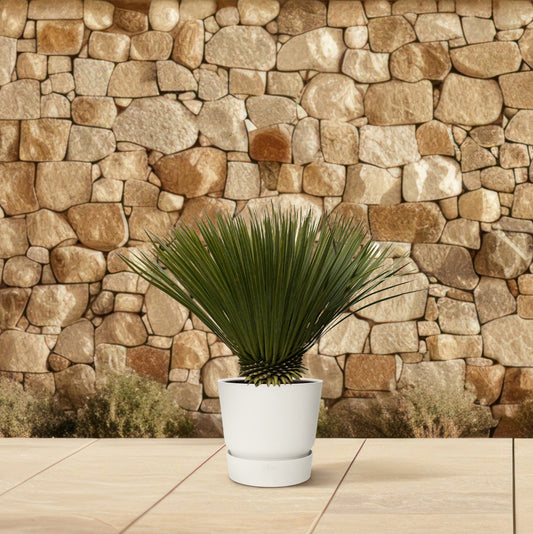
Canary Island date palm (Phoenix canariensis): growing, frost tolerance, care

To successfully grow a Phoenix canariensis, plant it in mid-spring in the sun, in perfectly drained soil and sheltered from the wind. Water it well during the first year, then remove only its dead fronds, never cutting flush with the trunk.
This Canary Island palm, also known as the Canary Island date palm or Phoenix palm, is a staple of the Côte d'Azur's grand avenues: a massive trunk and a dense crown of arching fronds. It can withstand brief frosts down to around -7 to -8 °C according to sources, which means it should only be planted outdoors in mild regions; elsewhere, it is grown in pots and overwintered in shelter.
It is one of the palms featured in our hardy exotic plants guide, which helps you determine where each plant is suitable according to your climate.
🌿 Phoenix canariensis, date palm or Phoenix roebelenii: don't confuse them
The Phoenix genus includes several palms with pinnate fronds, but only three are commonly found in garden centres, and they differ in size and hardiness.
The Canary Island palm is the largest: the University of Florida Institute of Food and Agricultural Sciences (UF IFAS) describes a trunk 60 to 90 cm in diameter (2 to 3 feet), marked with diamond-shaped leaf scars, and rigid fronds 2.4 to 4.5 m long bearing up to 200 leaflets.
The date palm (Phoenix dactylifera) is the species that produces commercial dates; the fruits of the Phoenix canariensis, meanwhile, are described by the North Carolina State University Extension (NC State Extension) as edible but not very tasty.
As for the Phoenix roebelenii, the RHS classifies it as H1B in its Phoenix roebelenii fact sheet: a dwarf palm 1.5 to 2.5 m tall, grown under cover for most of the year, and therefore mainly indoors in our country.
| Strength | What this means for you |
|---|---|
| Phoenix canariensis: thick trunk, dense crown | Monumental silhouette for a large coastal garden or a large pot on a terrace |
| Slow growth | It stays at pot size for a long time: the RHS estimates it takes 20 to 50 years to reach its adult size |
| Tolerant of drought and sea spray | Once established, suitable for dry gardens and seaside locations according to UF IFAS and NC State |
| Phoenix roebelenii: dwarf size | The indoor alternative (RHS H1B), which should not be bought for planting outdoors |
🔎 The Canary Island palm's ID card
According to Plants of the World Online (POWO) from the Royal Botanic Gardens, Kew, the accepted name is Phoenix canariensis H.Wildpret, published in 1882, a tree in the Arecaceae family originating solely from the Canary Islands, which grows mainly in the subtropical biome.
POWO lists it as introduced in many countries, including Spain, Italy, Sicily, Greece, Algeria, Tunisia, the Azores and Madeira, but also northwest Mexico, Bermuda and several Australian states.
Regarding cultivation, the RHS Phoenix canariensis fact sheet (Royal Horticultural Society) describes an arborescent palm with a sturdy trunk, dark green fronds up to 5 m long, and classifies it as H2 (1 to 5 °C): in the United Kingdom, it is grown under cover. This cautious classification does not contradict the resistance to brief frosts mentioned below.
| Criterion | Verified detail |
|---|---|
| 🏷️ Botanical name | Phoenix canariensis H.Wildpret (1882), accepted name by POWO |
| 🧬 Family | Arecaceae (Arecaceae), the palm family |
| 🌳 Type | Evergreen palm with a single trunk and pinnate fronds |
| 🌍 Origin | Canary Islands; introduced notably in Spain, Italy, Greece, Algeria and Tunisia (POWO) |
| ❄️ Hardiness | Around -8 °C (RHS, hardy palms); USDA zone 9A, above around -7 °C (UF IFAS); RHS H2 (1 to 5 °C) in the United Kingdom |
| 🍃 Foliage | Dark green fronds up to 5 m (RHS), basal leaflets transformed into spines 5 to 20 cm long (NC State) |
| 🌸 Flowering | Drooping panicles of cream-yellow flowers in spring, distinct male and female flower stalks (NC State) |
| 📏 Adult size | More than 12 m tall by 8 m (RHS); 12 to 18 m tall according to NC State |
📋 Quick technical sheet
The essential cultivation points, all at a glance.
| Parameter | Guideline |
|---|---|
| Exposure | Sun, south or west orientation, sheltered location (RHS) |
| Soil | Well drained, loamy, acidic to neutral (RHS); 25 cm mound in clay soil |
| Hardiness | Around -8 °C (RHS); USDA zone 9A, i.e., around -7 °C (UF IFAS) |
| Watering | Generous during the 1st year; drought tolerant once established (NC State) |
| Planting | Mid-spring, to settle in before winter (RHS) |
| Pruning | Dead fronds only, without cutting flush with the trunk; disinfected tools |
| Foliage | Evergreen, arching pinnate fronds, trunk with diamond-shaped scars |
| Maintenance/difficulty | Easy in mild climates; delicate in pots and below -7 °C |
| Toxicity | Non-toxic to dogs, cats and horses (ASPCA, NC State); dangerous spines |
📍 Where and when to plant a Canary Island palm?
Plant your Canary Island palm in full sun, in a sheltered spot: the RHS hardy palms guide reserves a sunny and well-drained location for it, and places it among the least hardy palms in its selection, with a limit of around -8 °C (18 °F).
The RHS advises planting palms in mid-spring, so they can establish their roots before winter. Plan ahead: NC State gives it a spread of 6 to 12 m, and its spines require it to be kept away from walkways. In France, planting outdoors is therefore reserved for the Mediterranean coast and the mildest Atlantic coasts; elsewhere, choose a pot.
☀️ Ideal: Mediterranean or mild Atlantic coastal garden, full sun, sandy or stony well-drained soil
🪴 In a pot: Sunny terrace in summer, bright shelter away from frost in winter, in colder regions
🚫 Avoid: Cold hollows, waterlogged soil in winter, beside a path or in a play area (spines)
🪴 Planting a Phoenix canariensis outdoors or in a pot
It all comes down to drainage. In heavy clay soil, the RHS recommends working the soil thoroughly and building a mound about 25 cm high before planting, so that winter water does not stagnate at the base.
It also advises keeping a young palm in a pot, in a peat-free soil (type John Innes No. 3), until it is well established. When transplanting an already large specimen, UF IFAS recommends removing about half of the lower two-thirds of the fronds and supporting the crown, as its bud is fragile.
| Step | The right approach |
|---|---|
| 1. Choose the time | Mid-spring, after frosts have passed, for establishment before winter |
| 2. Prepare the soil | Loosen thoroughly; in clay soil, a mound about 25 cm high |
| 3. Install the root ball | At the same level as in the pot, without burying the trunk, gloves and goggles on hand |
| 4. Water and mulch | Generous watering, mineral mulch at the base |
| 5. In a pot | Large pot with drainage holes, well-draining soil, saucer emptied after watering |
columns: 4
columns_mobile: 2
-

 Livraison offerte
Chinese Windmill Palm (Trachycarpus fortunei) - hardy palm
Regular price From 49,95 €Regular price -

 Livraison offerte
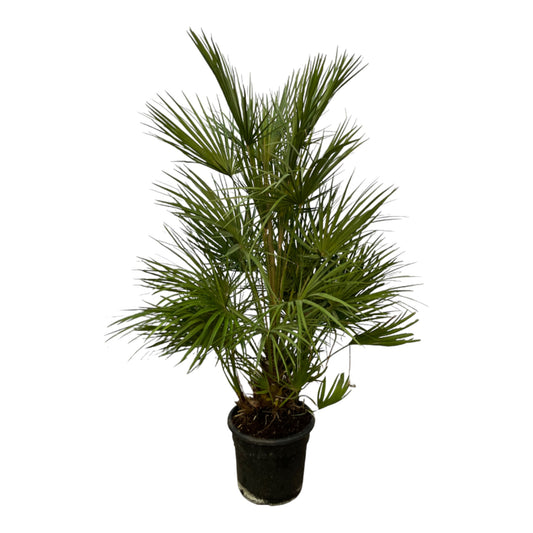
Mediterranean dwarf palm (Chamaerops humilis) - evergreen palm
Regular price From 49,95 €Regular price -

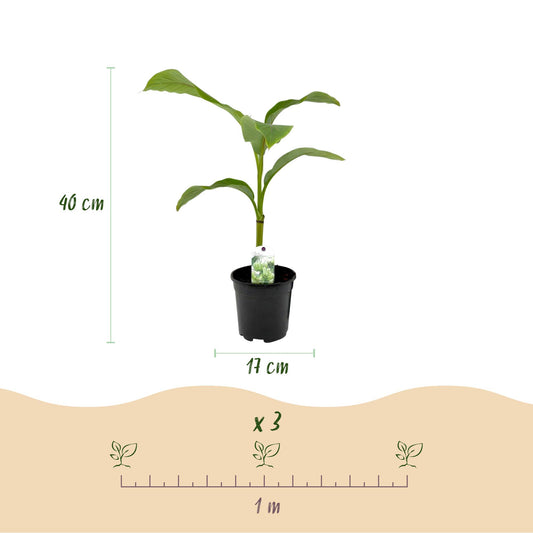
Hardy banana plant (Musa basjoo) - hardy banana plant with exotic green foliage - 17 cm pot - Height 40 cm
Regular price From 69,95 €Regular price


✂️ Phoenix canariensis maintenance: watering, fertilizer and fronds
An established Canary Island palm requires little care. NC State says it is drought tolerant once established, and the Phoenix canariensis is moderately tolerant of sea spray according to UF IFAS: water it especially during the first year and during long summer droughts. Too much water is more dangerous than too little: NC State associates the blackening of frond tips with overwatering.
In a pot, the RHS advises moderate watering and a balanced fertilizer every month during growth, then reduced watering in winter. Outdoors, UF IFAS recommends three fertilizer applications per year in the southeastern United States, as this palm often suffers from potassium and magnesium deficiencies.
💧 Establishment watering: Generous during the first year, allowing the soil to dry out between applications
💧 Adult watering: Deep watering during prolonged droughts; never standing water
🌱 Fertilizer: Palm fertilizer providing potassium and magnesium, from spring through the end of summer
🔹 Fronds: Remove only dead fronds, without cutting flush with the trunk (RHS)
👀 Monitoring: Spider mites and scale in pots, crown and central fronds in summer
🍂 Pruning and overwintering a Canary Island palm through the seasons
The RHS indicates that no pruning is necessary: simply remove the lower dead and unsightly fronds, without cutting them flush with the trunk.
UF IFAS warns against excessive pruning and trunk wounds, and its fact sheet on Fusarium wilt of the Canary Island palm explains that Fusarium wilt spreads from one palm to another mainly through contaminated pruning tools: disinfect them, or change tools between two palms.
NC State specifies that spines frequently injure pruners and recommends protective equipment, including goggles. In winter, the RHS advises wrapping outdoor palms if prolonged frosts are forecast, and protecting or bringing potted palms indoors.
📅 Maintenance calendar by season
| Season | Key action |
|---|---|
| 🌸 Spring | Planting in mid-spring, resuming fertilizer, removing dead fronds from winter |
| ☀️ Summer | Deep watering during drought, palm fertilizer, cream-yellow flowering, crown monitoring |
| 🍂 Autumn | Stop fertilizer, prepare pots for overwintering and bring them in before the first frosts |
| ❄️ Winter | Wrapping outdoor specimens during prolonged frost, sheltered pot away from frost, reduced watering |
🌱 Propagating a Phoenix canariensis: sowing
The Canary Island palm is propagated by sowing, the only method cited by the RHS, at a temperature of at least 25 °C. UF IFAS specifies that seeds germinate in 2 to 3 months at around 29 to 35 °C (85 to 95 °F), provided the growing medium is kept moist.
As male and female flowers are borne on different stalks (NC State), only a pollinated female stalk produces fertile seeds. Above all, plan for patience: growth is slow, and a seedling takes years to form a real trunk.
🐛 Common problems: causes and solutions
The first problem of the Phoenix canariensis in France remains the cold: burned fronds, then the heart affected if the bud has frozen. Next come nutrient deficiencies, easily recognized on old fronds, and the diseases described by UF IFAS and NC State (Fusarium wilt, rot, leaf spots).
In pots, NC State notes spider mites, scale and thrips; our guide to natural treatments for mealybug helps you act early. Two regulated pests are treated just after the table.
| Symptom | Probable cause | Solution |
|---|---|---|
| Browned and dry fronds after winter | ❄️ Frost or freezing wind | Wait for spring growth, remove only completely dry fronds |
| Blackening frond tips | ⚠️ Overwatering (NC State) | Space out watering, check soil or pot drainage |
| Translucent then necrotic spots on old fronds | 🌱 Potassium deficiency (UF IFAS) | Palm fertilizer rich in potassium; do not cut these fronds while they are still green |
| Lemon-yellow bands on the edges of old fronds | 🌱 Magnesium deficiency (UF IFAS) | Palm fertilizer containing magnesium |
| Brown leaflets on one side, reddish-brown streak on the petiole | ⚠️ Fusarium wilt, transmitted by tools (UF IFAS) | No cure according to UF IFAS: disinfect tools, get a diagnosis |
| Central fronds declining, top sagging | ⚠️ Red palm weevil possible | Report quickly to state services (DRAAF), which prescribe control measures |
-

Banana plants, ensetes and exotic plants for a lush garden — hardiness...
-

Outdoor plants that keep their foliage all year round: evergreen privacy hedges,...


🌿 Our selection to go further
To go further, here are our guides and collections to create an exotic or Mediterranean garden around the Canary Island palm.
| Our selection | Why choose it |
|---|---|
| comparison of hardy exotic plants | Our comparison to choose the exotic plant suited to your winter, from the most sensitive to the most hardy |
| palmier chanvre (Trachycarpus fortunei) | The hardiest palm tree for regions where the Phoenix cannot survive outdoors in winter |
| exotic plants to pair with the Phoenix | Our collection of banana trees and exotic plants to complete the tropical atmosphere |
| Mediterranean plants | Our sun-loving Mediterranean plants, natural companions of the Canary Island date palm |
🎨 What plants to pair with a Phoenix canariensis?
The Canary Island date palm naturally finds its place in a Mediterranean garden or a dry garden, among grasses, lavender, and an olive tree that share its love of sun and drainage.
For a tropical atmosphere, pair it with the Japanese banana tree (Musa basjoo) and agapanthus, or browse our plants for balconies and terraces.
If your winter is too harsh, the dwarf palm (Chamaerops humilis) and the Washingtonia, the skirt palm offer other palm silhouettes to compare. And for a Phoenix indoors, consult our indoor palm guide, including the Phoenix roebelenii.
⚠️ Is the Phoenix canariensis dangerous for children and animals?
According to the Canary Date Palm fact sheet from the ASPCA (American Society for the Prevention of Cruelty to Animals), which specifically covers Phoenix canariensis, the species is non-toxic to dogs, cats, and horses; the NC State fact sheet also classifies it as non-toxic.
The real danger is mechanical: NC State describes sharp spines 5 to 20 cm (2 to 8 inches) long at the base of the fronds, which frequently injure people who handle them.
Plant it away from walkways and play areas, and wear thick gloves and goggles during any work.
Red palm weevil and palm moth. The Phoenix canariensis is a major host of the red palm weevil (Rhynchophorus ferrugineus) in the EPPO database (European and Mediterranean Plant Protection Organization), which has listed it since 2019 as a non-quarantine regulated organism in the European Union (Regulation 2019/2072).
In France, the page dedicated by the Ministry of Agriculture (published in 2017) describes it as a category one health hazard, with control made mandatory by the decree of July 21, 2010: owners, including private individuals, must take the measures prescribed by state services.
The palm moth (Paysandisia archon) also appears on the list of host plants for the palm moth for the Phoenix canariensis. As rules may change, consult your town hall or your regional DRAAF if in doubt.
✅ Our expert tips for success
A successful Canary Island date palm depends on three choices: the right climate, the right soil, and the right place. Reserve full ground planting for regions where winter temperatures remain above -7 to -8 °C, plant in mid-spring in perfectly drained soil, and give it space for its fronds and spines.
Water it during the first year, feed it with potassium and magnesium, only remove dead fronds with disinfected tools, and monitor its crown. Outside of mild regions, grow it in a pot and follow our tips for protecting your plants from frost.
The Canary Island date palm is often the dream you bring back from a trip to the South, and it is also the one for which I ask the most questions before advising. I first ask where it will be planted and how the soil behaves in winter, because it is standing water, as much as the cold, that causes palms trouble. I also warn about its spines: we tend to forget them at the garden center, much less when repotting it. When the climate is borderline, I suggest starting in a pot, while you get to know it.

Laura Bruneau
Jardinière & autrice