Passionflower: Planting, Pruning, and Hardiness in the Garden

Passionflower, or passion flower, produces one of the garden’s most astonishing blooms: an arrangement of petals, filaments and colorful crowns, renewed from June to October. A vigorous, fast-growing climber, it covers a wall or trellis in a single season. The hardiest varieties, such as blue passionflower, can stay outdoors through winter in much of France.
This guide explains how to plant, prune and protect it.
🌿 Why plant passionflower?
Plant passionflower for its spectacular blooms and rapid growth, which cover a support in a single season. Each intricately structured flower is continually replaced from summer to fall. Blue passionflower is the hardiest and can be grown in the ground in many regions.
The RHS (Royal Horticultural Society) notes that a warm, sheltered spot, such as against a south-facing wall, is key to getting it to flower and survive the winter.
| Benefit | What it brings to the garden |
|---|---|
| Unique blooms | Intricately structured, spectacular flowers, renewed from June to October |
| Fast growth | A vigorous climber that covers a wall or trellis in a single season |
| Blue passionflower is hardy | Once established and sheltered, Passiflora caerulea tolerates around -10 to -15 °C |
| Evergreen in the south | Partly evergreen in mild climates, it retains its ornamental, deeply lobed foliage |
🔎 Passionflower at a glance
Passionflower belongs to the genus Passiflora, in the Passifloraceae family, which includes hundreds of mostly tropical species. The most widely grown outdoors is Passiflora caerulea, or blue passionflower, described by the RHS as the hardiest species in the genus. It climbs by means of tendrils and has distinctive lobed foliage.
Its blue-and-white flowers can produce orange fruits that are ornamental but bland; do not confuse them with the edible passion fruit (Passiflora edulis).
| Feature | Verified details |
|---|---|
| 🏷️ Botanical name | Passiflora caerulea (blue passionflower) |
| 🧬 Family | Passifloraceae |
| 🌍 Origin | South America |
| 🌳 Type | Tendril-climbing, semi-evergreen to deciduous |
| 📏 Height | 4 to 6 m when trained |
| 🌸 Flowering | Intricately structured flowers (8 to 10 cm) from June to October |
| ☀️ Exposure | Full sun, warm and sheltered (south-facing wall) |
| 🌱 Soil | Well-drained, ordinary, on the moist side |
| 🍒 Fruiting | Ornamental orange fruits (caerulea, bland) |
| ❄️ Hardiness | Around -10 to -15 °C (caerulea) |
📋 Quick growing guide
Essential facts at a glance.
| Parameter | Guideline |
|---|---|
| Botanical name | Passiflora caerulea |
| Family | Passifloraceae |
| Type | Tendril-climbing |
| Exposure | Full sun, sheltered south-facing wall |
| Soil | Well-drained, ordinary, moist |
| Hardiness | -10 to -15 °C (caerulea) |
| Height | 4 to 6 m |
| Flowering | June to October |
| Support | Trellis, wire mesh, wires (climbs by tendrils) |
| Lifespan | Several years |
📍 Where and when to plant passionflower: warmth and shelter
Plant passionflower in a warm, sheltered spot against a south-facing wall—the ideal location for abundant blooms and a better chance of getting through winter. Full sun is essential. The soil should be ordinary, well-drained and on the moist side; passionflower cannot tolerate waterlogged soil in winter, which can be fatal. Provide a sturdy support (trellis, wire mesh, wires) for its tendrils to cling to.
Plant in spring, after the last frosts, to give it the entire growing season to establish well before winter.
☀️ Exposure: Full sun, sheltered south-facing wall
🌱 Soil: Well-drained, ordinary, moist
❄️ Climate: -10 to -15 °C (caerulea)
🪴 How to plant passionflower, step by step
Plant passionflower in spring, once all risk of frost has passed. The essentials are a warm, sheltered spot, well-drained soil and a support in place. Regular watering during the first season helps it establish well before winter.
| Step | What to do |
|---|---|
| Soak | Submerge the root ball in a bucket of water until thoroughly soaked |
| Install the support | Attach a trellis or wires to the wall before planting |
| Dig | Dig a loosened, well-draining hole at the base of the support |
| Plant | Set the crown level with the soil, backfill and firm down |
| Water and mulch | Water generously, then mulch to retain moisture and protect it over winter |
columns: 4
columns_mobile: 2
-

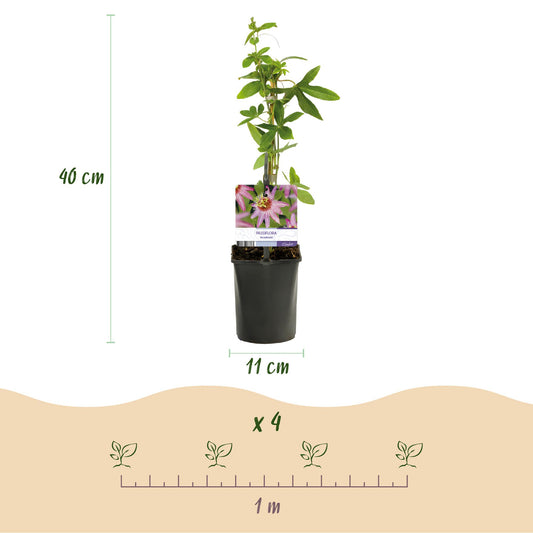
'Anastasia' Passionflower (Passiflora) – flowering climbing plant – 11 cm pot – 40 cm tall – Set of 2
Regular price 39,95 €Regular price39,95 €31,96 €Livraison offerte -

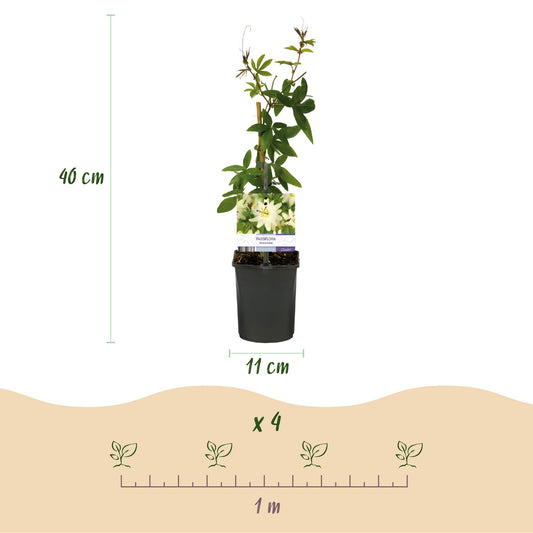
'‘Avalanche’ passionflower (Passiflora) – flowering climber – 11 cm pot – 40 cm tall – pack of 2
Regular price 39,95 €Regular price39,95 €31,96 €Livraison offerte -


' Damsel's Delight' passion flower (Passiflora) – flowering climber – 11 cm pot – 40 cm tall – pack of 2
Regular price 39,95 €Regular price39,95 €31,96 €Livraison offerte -

 Livraison offerte
Passionflower (Passiflora) – flowering climber – 9 cm pot – 35 cm tall
Regular price From 39,95 €Regular price39,95 €From 31,96 €Livraison offerte


✂️ Passionflower care: spring pruning and winter protection
Passionflower mainly needs spring pruning to thin it out and keep it in bounds, plus winter protection in borderline climates. It is vigorous and tends to become tangled, so guide and thin it each year as growth resumes.
✂️ Pruning: In spring, thin and shorten the stems to let air through and keep the climber in bounds
🧗 Training: Guide young stems onto the support; passionflower climbs by means of its tendrils
💧 Watering: Water in summer, especially in pots; keep the soil moist but never waterlogged
🧣 Winter protection: Apply a thick layer of mulch around the base; in cold climates, protect the crown or bring potted plants indoors
🌱 Feeding: A light application in spring is enough; too much nitrogen encourages leaves at the expense of flowers
🍂 Passionflower through the seasons
Passionflower's annual cycle revolves around its long summer flowering period and winter protection. Spring is the time to prune and plant. Summer and fall bring a succession of flowers. In cold climates, winter calls for vigilance.
📅 Seasonal care calendar
| Season | Key task |
|---|---|
| 🌸 Spring | Plant after frosts, thin-prune and watch for vigorous new growth; guide young stems onto the support. |
| ☀️ Summer | Long, spectacular flowering from June to October; water regularly as the climber covers its support. |
| 🍂 Fall | Flowering continues, ornamental orange fruits appear, and a thick layer of mulch is applied around the base before winter. |
| ❄️ Winter | Dormant period: do not prune; protect the crown from the cold. In mild climates, the lobed foliage remains. |
🌱 How do you propagate passionflower?
Passionflower is easy to propagate from 10 to 15 cm stem cuttings taken in summer, which root well under cover, or by layering long stems laid on the ground. Seeds can be sown, but this is slower and less reliable for named cultivars. Cuttings remain the simplest and most reliable way to reproduce a passionflower you love.
🐛 Common problems: diseases, pests and mistakes
Passionflower is vigorous and rarely suffers from disease; its real enemies are cold, wet winter conditions and, sometimes, excessive vegetative growth at the expense of flowers. Here’s what to do.
| Symptom | Likely cause | Solution |
|---|---|---|
| Base fails to regrow in spring | 🍄 Cold, wet conditions; crown frozen or rotted | Plant in well-drained soil against a warm wall and apply a thick layer of mulch for winter |
| Lots of leaves, few flowers | 💧 Too much nitrogen or a spot that is too cool | Reduce feeding and give it full sun against a south-facing wall |
| Tangled, untidy climber | ⚠️ Unchecked vigorous growth | Thin and guide the stems onto the support each spring |
| Yellowing foliage in a pot | 💧 Lack of water or exhausted potting mix | Water regularly and repot or refresh the top layer of potting mix in spring |
-

Clematis, wisteria, passionflowers, climbing roses and star jasmine to adorn walls, pergolas...


🌸 Our passionflower varieties
Choosing a variety largely comes down to the hardiness you need. Here are some reliable choices, with blue passionflower the top pick for growing in the ground.
| Variety | Its appeal |
|---|---|
| Caerulea (blue) | Blue passionflower, the hardiest (~-10 to -15 °C), with blue-and-white flowers |
| Constance Elliott | Fragrant ivory-white flowers; one of the hardiest and an elegant choice |
| Anastasia | Large, colorful flowers; a vigorous, free-flowering climber |
| Avalanche | Abundant white blooms, with flowers cascading over a support |
| Damsels Delight | Unusual, highly ornamental flowers and vigorous growth |
🎨 Where to plant it and what to pair it with
Plant passionflower against a warm wall or on a pergola, alongside other garden climbers: it takes over in summer from a clematis or spring-flowering rose. Its lobed foliage and intricately structured flowers make a statement on their own. Give it the warmest, most sheltered spot and well-drained soil. Avoid cold, damp locations, which it cannot tolerate in winter.
⚠️ Is passionflower toxic?
Caution is advised: the green parts (leaves and stems) of some passionflowers, including blue passionflower, contain cyanogenic compounds that may be toxic if ingested in large quantities, both to people and animals. The orange fruits of Passiflora caerulea are considered bland and are not generally recommended for eating; do not confuse them with edible passion fruit.
Keep pets and young children away from the plant, and seek medical or veterinary advice if any part is ingested.
✅ Our expert tips for success
To grow passionflower successfully, remember the essentials: give it the warmest, most sheltered wall in the garden, well-drained soil and a good support, and apply a thick layer of mulch for winter. Prune in spring to thin it out, never in fall. Follow these steps and from June to October, the passion flower will reward you with one of the most spectacular and fascinating displays a climber can offer.
Passionflower fascinates everyone with its incredible flowers, but I often see people disappointed because they chose the wrong location. It’s not a climber you can plant just anywhere: give it the warmest wall, facing due south, and soil that never stays waterlogged in winter. Mulch around the base, and even if the top growth freezes, the crown will regrow. In the right spot, blue passionflower is far hardier than you might think.

Laura Bruneau
Jardinière et autrice