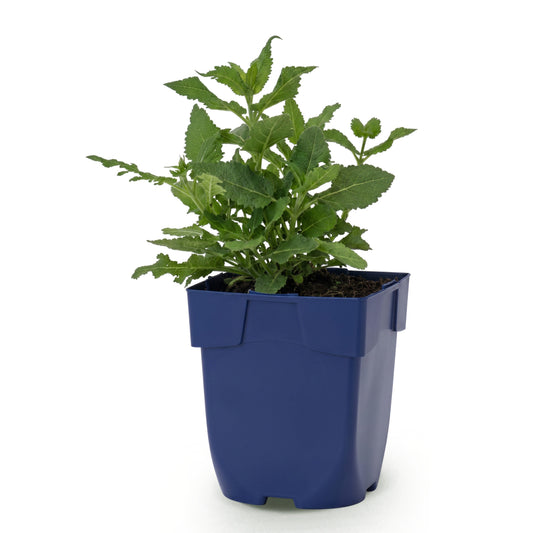
Gaura (Gaura lindheimeri): planting, pruning and care

To grow gaura successfully, plant it in full sun in well-drained soil, even if it is poor, water it only while it establishes, add very little fertilizer, and cut back its stems in spring rather than autumn. Gaura lindheimeri, or Lindheimer’s gaura, bears white or pink flowers on long, flexible stems that seem to flutter above the flower bed.
Botanists now call it Oenothera lindheimeri, but garden centers and nurseries still use the name Gaura. It naturally belongs in our guide to creating an easy perennial flower bed, among sun-loving perennials and ornamental grasses.
This guide brings together information verified against the RHS, Kew botanists, NC State Extension, and the University of Wisconsin, along with planting, pruning, and overwintering advice.
🌿 Why plant gaura in your flower bed
Gaura brings something often missing from a flower bed: lightness and movement.
According to the RHS (Royal Horticultural Society), 'Whirling Butterflies' produces airy spikes of delicate white flowers with long stamens, opening from pink buds over an extended period, from late spring to early autumn.
According to NC State Extension, flowering continues until the first autumn frosts, and the flowers attract bumblebees, long-tongued bees, and butterflies. Once established, the plant tolerates drought and requires little maintenance.
| Benefit | What it means for your garden |
|---|---|
| Flowers for several months | Flowers from late spring until the first frosts, with no significant interruption |
| Airy effect | Fine stems sway in the breeze and lighten overly dense flower beds |
| Low water needs | Once rooted, the plant tolerates drought in the ground |
| Beneficial to pollinators | Bumblebees, bees, and butterflies visit its flowers all summer |
🔎 Gaura lindheimeri at a glance
According to Plants of the World Online (POWO) from the Royal Botanic Gardens, Kew, the accepted name is Oenothera lindheimeri (Engelm. & A.Gray) W.L.Wagner & Hoch, published in 2007: the genus Gaura was merged into Oenothera, and Gaura lindheimeri Engelm. & A.Gray, described in 1845, became a synonym. It belongs to the evening primrose family, Onagraceae.
Its natural range is limited to southeastern Texas and southwestern Louisiana; POWO records it as introduced in around ten regions, including Corsica, Spain, and Italy.
According to NC State Extension, the species reaches 3 to 5 feet in height, or about 90 cm to 1.5 m, and 1 to 2 feet wide, or about 30 to 60 cm.
| Feature | Verified details |
|---|---|
| 🏷️ Botanical name | Oenothera lindheimeri (syn. Gaura lindheimeri Engelm. & A.Gray) |
| 🧬 Family | Evening primrose family (Onagraceae) |
| 🌳 Type | Deciduous herbaceous perennial, growing in a clump, with a woody taproot |
| 🌍 Origin | Southeastern Texas and southwestern Louisiana (POWO) |
| ❄️ Hardiness | H4 according to the RHS for 'Whirling Butterflies' and 'Siskiyou Pink', or -10 to -5 °C |
| 🍃 Foliage | Narrow, lance-shaped leaves, in a basal rosette and then along the stems |
| 🌸 Flowers | Four-petaled flowers, white or pink, from late spring to autumn (RHS) |
| 📏 Mature size | 0.5 to 1.5 m tall depending on variety (RHS), about 90 cm to 1.5 m for the species (NC State) |
📋 Quick growing guide
Essential growing information at a glance.
| Factor | Guideline |
|---|---|
| Position | Full sun, at least 6 hours a day (NC State); tolerates partial shade |
| Soil | Well-drained, preferably light; clay is fine if water drains away |
| Hardiness | RHS H4: -10 to -5 °C; USDA zones 5a to 9b according to NC State |
| Watering | At planting and while establishing; sparingly thereafter |
| Planting | Preferably in spring; divide clumps in spring |
| Pruning | Cut back in spring; cut back by half in late spring if the clump flops |
| Flowering | Late spring to early autumn, continuing until frost |
| Maintenance | Easy; use little fertilizer and remove spent flowers to limit self-seeding |
| Toxicity | No ASPCA profile; the RHS and NC State Extension provide no information |
📍 Where and when to plant gaura
Plant gaura in a sunny spot, in soil where water never sits. For 'Whirling Butterflies', the RHS recommends full sun or partial shade, a south- or west-facing aspect, chalky, loamy, or sandy soil of any pH, and a sheltered or exposed site.
According to the University of Wisconsin Horticulture Extension, gaura prefers light soils and tolerates clay as long as it is well drained; root rot is a risk in heavy, poorly drained soil. Plant preferably in spring, so the taproot can establish before summer and well ahead of winter.
☀️ Ideal: A sunny flower bed or border, dry garden, wildflower meadow, or well-drained slope
🌥️ Acceptable: Light partial shade, or a large, deep pot on a sunny patio
🚫 Avoid: Shade, heavy soil waterlogged in winter, very rich or manured soil
🪴 Planting gaura in the ground or in a pot
Good drainage is the key to success. In the ground, loosen the soil deeply without enriching it: NC State Extension advises against overly rich soil, which encourages foliage at the expense of flowers. Add gravel to heavy soil.
Space plants according to the spread of the variety: 10 to 50 cm for 'Whirling Butterflies', and 50 cm to 1 m for 'Siskiyou Pink', according to the RHS. In a pot, choose a deep container for the taproot, with drainage holes, and use potting mix lightened with sand or gravel; the RHS notes that plants in pots are more sensitive to cold.
| Step | What to do |
|---|---|
| 1. Choose a spot | Full sun, soil that never stays waterlogged, in a flower bed or border |
| 2. Prepare the soil | Loosen deeply, add gravel to heavy soil, and do not add manure |
| 3. Set the root ball | At soil level, without burying the crown, firming gently |
| 4. Water | Water well at planting, then whenever the soil dries out while the plant establishes |
| 5. Leave room | Allow for the variety’s spread and pair it with neighbors that will support it |
columns: 4
columns_mobile: 2
-

 Livraison offerte Sold out
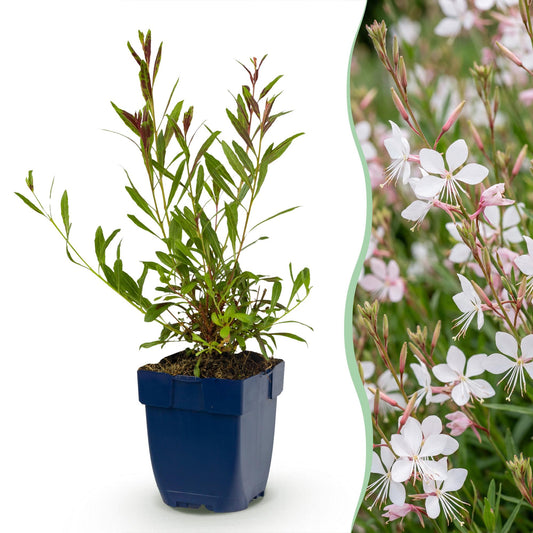
Gaura 'Whirling Butterflies' (Gaura lindheimeri) - melliferous perennial - 11 cm pot - Height 25 cm
Regular price From 39,95 €Regular price39,95 €From 31,96 €Livraison offerte Sold out -

 Livraison offerte Sold out
Gaura 'Florgauros' (Gaura lindheimeri) - melliferous perennial - 11 cm pot - Height 25 cm
Regular price From 39,95 €Regular price39,95 €From 31,96 €Livraison offerte Sold out -


Buenos Aires verbena ‘Lollipop’ (Verbena bonariensis) – nectar-rich perennial – 11 cm pot – height 25 cm
Regular price From 39,95 €Regular price39,95 €From 31,96 €Livraison offerte -

 Livraison offerte Sold out
‘Butterfly Blue’ Pincushion Flower (Scabiosa columbaria) – nectar-rich perennial – 11 cm pot – height 25 cm
Regular price From 39,95 €Regular price39,95 €From 31,96 €Livraison offerte Sold out -


‘Six Hills Giant’ Catmint (Nepeta faassenii) – bee-friendly perennial – 11 cm pot – Height: 25 cm
Regular price From 39,95 €Regular price39,95 €From 31,96 €Livraison offerte -


Coneflower 'Magnus' (Echinacea purpurea) - melliferous perennial - 11 cm pot - Height 25 cm
Regular price From 39,95 €Regular price39,95 €From 31,96 €Livraison offerte -

 Livraison offerte Sold out
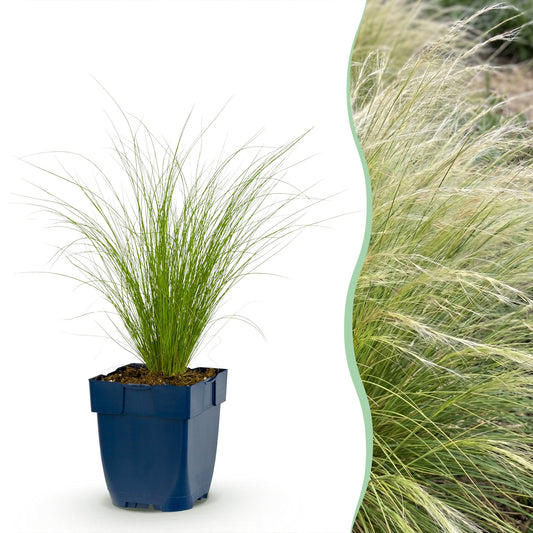
Angel's hair 'Ponytails' (Stipa tenuissima) - ornamental grass - 11 cm pot - Height 25 cm
Regular price From 39,95 €Regular price39,95 €From 31,96 €Livraison offerte Sold out -


Ornamental sage 'Schneehügel' (Salvia nemorosa) – nectar-rich perennial – 11 cm pot – height 25 cm
Regular price From 39,95 €Regular price39,95 €From 31,96 €Livraison offerte


✂️ Gaura care: watering, fertilizer, and spent flowers
Gaura care comes down to restraint. According to the University of Wisconsin, water and fertilize sparingly to encourage a compact shape and more flowers; once established, it tolerates drought, although adequate moisture improves flowering. Cutting off spent flower spikes encourages further flowering and limits self-seeding.
The RHS describes it as generally free from pests and diseases.
💧 Watering: In the ground, while establishing and during prolonged dry spells; in pots, when the surface of the potting mix has dried
🌱 Fertilizer: Not needed in the ground; overly rich soil makes the stems flop
🔹 Spent flowers: Cut off spent spikes to extend flowering and limit self-seeding
🪢 Staking: Instead of stakes, plant sturdy neighbors that will support the stems
🧣 Winter: Leave dry stems in place; in pots, raise the container and shelter it from rain
🍂 When and how to prune gaura through the seasons
Wait until spring to prune gaura: for 'Whirling Butterflies', the RHS recommends delaying the cut until spring. NC State Extension suggests cutting off flower spikes in autumn and removing dry foliage in spring; both approaches work, but leaving the stems in place over winter protects the crown.
If the clump tends to flop, the University of Wisconsin recommends shearing it in late spring, cutting back up to half its height. As for cold, the RHS H4 rating corresponds to -10 to -5 °C according to the RHS hardiness rating scale: winter soil moisture is the main thing to avoid.
📅 Seasonal care calendar
| Season | Key task |
|---|---|
| 🌸 Spring | Remove dry stems, plant, and divide; cut back by half in late spring if needed |
| ☀️ Summer | Peak flowering; remove spent spikes; water pots as needed |
| 🍂 Autumn | Flowers continue until the first frosts; sowing is possible according to the University of Wisconsin |
| ❄️ Winter | Dormancy; leave stems in place, keep soil well drained, and raise pots and shelter them from rain |
🌱 Sowing, division, and propagation by cuttings
According to the University of Wisconsin, the species is easy to propagate from seed in spring or autumn, by division in spring, and by basal cuttings in summer; however, many cultivars can only be propagated vegetatively. The RHS also recommends softwood cuttings in spring and semi-ripe cuttings in summer.
Gaura readily self-seeds: transplant young seedlings that appear at the base of the clump. For a specific variety such as 'Whirling Butterflies', which NC State describes as having sterile flowers, use cuttings instead.
🐛 Common problems: causes and solutions
Gaura has few problems, but failures almost always have the same causes: soil that is too wet, too rich, or too shaded. NC State Extension lists root rot in poorly drained soil, rust and powdery mildew, as well as aphids, whiteflies, and flea beetles. Here’s how to interpret the signs.
| Symptom | Likely cause | Solution |
|---|---|---|
| Stems flop and spread apart | ☀️ Soil is too rich or there is not enough sun (Wisconsin) | Stop fertilizing, move to a sunny spot, and cut back by half in late spring |
| Clump fails to regrow in spring | 💧 Soil waterlogged over winter or temperatures below the H4 threshold | Replant in well-drained soil, leave stems in place over winter, or transplant a seedling |
| Brown, soft crown | 🍄 Root rot in heavy soil | Dig it up, improve the soil with gravel, and water less |
| White powder on the leaves | 🍄 Powdery mildew | Thin the clump, remove affected parts, and avoid watering the foliage |
| Orange pustules | 🍄 Rust | Remove affected leaves and avoid wetting the foliage |
| Lots of leaves, few flowers | 💧 Excess nitrogen or water | Stop fertilizing and water only during dry spells |
-

Nectar-producing plants & pollinators
Provide food for bees, bumblebees, and butterflies: our selection of outdoor nectar-rich...


🌸 Our gaura varieties
White or pink, compact or tall: here are the best-documented gauras, including the two we offer in 11 cm pots.
| Variety | What makes it special |
|---|---|
| Gaura 'Whirling Butterflies' | White flowers opening from pink buds, 0.5 to 1 m tall, H4 according to the RHS; sterile flowers according to NC State |
| Gaura 'Florgauros' | Sold under this trade name; we could not find a reference description, so please refer to the product page |
| 'Siskiyou Pink' | Flowers in an antique pink shade, about 2.5 cm across; 1 to 1.5 m tall according to the RHS; cut back after flowering |
| Geyser Pink ('Gaudros') | Geyser series: pink flowers in long panicles, bushy clump about 80 cm tall according to the RHS |
| 'Snowstorm' | White, a University of Minnesota selection cited by NC State for USDA zone 6 |
| Ballerina series | Compact, about 30 to 45 cm, with sterile flowers according to the University of Wisconsin: ideal for pots |
🎨 What to plant with gaura
Gaura pairs well with sun-loving perennials that have similar water needs. The combination of gaura and agapanthus is a classic: the blue spheres of agapanthus stand out against the white cloud of gaura.
Add a perennial sage, an coneflower or purpletop vervain, all of which share its airy look. Meadow grasses support its stems and extend the prairie effect suggested by the RHS.
To plan your border, browse our gaura and other border perennials, our nectar-rich plants and our outdoor flowering plants, or explore all our outdoor plants.
⚠️ Is gaura toxic or invasive?
As for toxicity, we could not find an ASPCA profile devoted to gaura, and neither the RHS nor NC State Extension reports any toxicity. A lack of information is not proof that it is harmless: do not let children or pets eat it. The University of Wisconsin notes that deer tend to avoid it.
As for its behavior, the species self-seeds readily and may naturalize, according to the University of Wisconsin; POWO (Kew) lists it as introduced in Corsica. We have not verified any official classification as an invasive species in France: cut off spent flower spikes near natural areas.
✅ Our expert tips for success
Growing gaura successfully comes down to four things: full sun, well-drained and fairly poor soil, pruning in spring, and companion plants that support it. Rated H4 by the RHS, meaning -10 to -5°C, it is more vulnerable to wet winters than to dry cold. As individual plants are not always very long-lived, let a few seedlings take their place.
In return, it flowers from late spring until the first frosts and feeds pollinators all summer.
Gaura is the perennial I recommend for softening up a border that looks too formal. I love watching its white flowers tremble in the slightest breeze among the sages and grasses. I never give it any fertilizer, and I leave its stems standing all winter before cutting them back in spring. When a plant starts to tire, a young seedling is often already there to take its place.

Laura Bruneau
Jardinière et autrice