Periwinkle (Vinca minor, Vinca major): planting and care

To grow periwinkle successfully, plant it in partial shade or light shade in moist but well-drained soil. Water it during its first year while it gets established, then cut it back hard in early spring to keep it dense and contained. Two closely related species are grown in gardens under the name periwinkle: lesser periwinkle, Vinca minor, and greater periwinkle, Vinca major.
These are evergreen, hardy ground covers with blue-violet flowers, among the few plants able to cover the ground beneath trees. This guide compares the two species using information verified with the RHS, Kew and NC State Extension, explains how to plant, prune and contain them, and clears up the common confusion with Madagascar periwinkle.
🌿 Lesser or greater periwinkle: which should you choose?
Choose lesser periwinkle for a low, fine-textured carpet, and greater periwinkle to cover a large area or slope quickly.
According to the RHS (Royal Horticultural Society), Vinca minor forms an evergreen carpet of glossy, dark green leaves, spreading 1 to 1.5 m per plant in 2 to 5 years. The RHS profile for greater periwinkle gives Vinca major a spread of 1.5 to 2.5 m and flowers about 4 cm across, noticeably larger.
According to North Carolina State University Extension (NC State Extension), lesser periwinkle grows only 8 to 15 cm (3 to 6 inches) tall, with narrow leaves less than 2.5 cm wide.
Among the cultivars, the RHS describes white forms (Vinca minor f. alba), purple ones ('Atropurpurea') and those with bright yellow leaves edged in green ('Illumination'). The same RHS database notes that 'La Grave', a name under which it is often sold, is a synonym for 'Bowles's Variety'.
The same rule applies to both species: plant them in a clearly defined area.
| Benefit | What this means for you |
|---|---|
| Lesser periwinkle (Vinca minor) | Low, dense carpet with fine leaves: ideal for borders, under trees and small gardens |
| Greater periwinkle (Vinca major) | Faster, taller coverage: useful on slopes or large areas, but harder to contain |
| Evergreen foliage | The ground stays green all year, leaving little room for weeds |
| Sun or shade | Grows from full sun to shade in almost any soil except very dry soil |
🔎 Periwinkle at a glance
According to Plants of the World Online (POWO), run by the Royal Botanic Gardens, Kew, the accepted name for lesser periwinkle is Vinca minor L., published by Linnaeus in 1753; its native range extends from Europe to the Caucasus and includes France and Corsica.
The same database places greater periwinkle, Vinca major L., also described in 1753, from southern Europe to the Caucasus, including France; both are perennials or subshrubs from temperate regions and belong to the Apocynaceae family.
According to NC State Extension, lesser periwinkle roots at each node along its trailing stems, allowing it to form a dense carpet over a large area and stabilize slopes against erosion.
Not to be confused with Madagascar periwinkle, Catharanthus roseus according to POWO, which is native to eastern and southern Madagascar. Hardy only in USDA Zones 10 and 11 according to NC State Extension, it is grown here as a summer annual and covered in a separate guide.
| Feature | Verified details |
|---|---|
| 🏷️ Botanical name | Vinca minor L. (lesser periwinkle) and Vinca major L. (greater periwinkle) |
| 🧬 Family | Apocynaceae |
| 🌳 Type | Evergreen perennial or subshrub; trailing ground cover |
| 🌍 Origin | Europe to the Caucasus (V. minor); southern Europe to the Caucasus (V. major); native to France according to POWO |
| ❄️ Hardiness | H6 according to the RHS, or -20 to -15°C, for both species |
| 🍃 Foliage | Evergreen, opposite glossy dark green leaves; variegated forms in cream or yellow |
| 🌸 Flowering | Blue-violet, white or purple; from mid-spring to late summer for V. minor (RHS) |
| 📏 Mature size | 10 to 50 cm tall; spread of 1 to 1.5 m (V. minor), 1.5 to 2.5 m (V. major) |
📋 Quick growing guide
The essential growing information, all at a glance.
| Parameter | Guideline |
|---|---|
| Position | Sun, partial shade or shade; more abundant flowering in sun (RHS) |
| Soil | Chalk, clay, loam or sand; moist but well-drained; any soil except very dry soil |
| Hardiness | H6 according to the RHS: -20 to -15°C (lesser and greater periwinkle) |
| Watering | Regularly during the first year; thereafter only during prolonged dry spells |
| Planting | Autumn or spring, avoiding frost and heatwaves |
| Pruning | Cut back hard in early spring (RHS); trim edges that spread beyond their boundaries |
| Flowering | Spring and summer, with possible repeat flowering into autumn |
| Care | Easy; keep an eye on how far the carpet spreads |
| Toxicity | Not classified by the RHS or NC State; do not eat, and keep out of pets' reach |
📍 Where and when to plant periwinkle
Plant periwinkle where little else will grow: beneath trees, under a hedge, on a shady slope or along a shaded path. The RHS says it grows in full sun or full shade, in any aspect and in exposed or sheltered sites; it notes that greater periwinkle flowers better in sun but remains very useful in shade.
According to NC State Extension, lesser periwinkle tolerates both near-full shade and heat. Plant container-grown specimens in autumn or spring, when the soil is not waterlogged, and avoid periods of frost or drought.
🌳 Ideal: Beneath deciduous trees, at the foot of a hedge or on a partially shaded slope, in a clearly defined area
☀️ Acceptable: Full sun in moist soil: more flowers, but watering may be needed in summer
🚫 Avoid: Very dry soil, beds of delicate perennials, and the edges of woodland or natural areas
🪴 How to plant periwinkle as ground cover
The key to successful ground cover is to weed thoroughly before planting: periwinkle spreads quickly, but cannot outcompete established perennial weeds. According to the RHS, it grows in chalky, clay, loamy or sandy soils, whether acidic or alkaline, as long as they are not very dry.
Loosen the soil, work in a little compost if it is poor, then plant in a staggered pattern. The closer together you space the plants, the faster the carpet will fill in; with wider spacing, you will have to wait longer for the ground to be fully covered.
| Step | What to do |
|---|---|
| 1. Prepare the area | Weed thoroughly, removing the roots of unwanted perennial weeds |
| 2. Loosen the soil | Work the soil and add compost if it is poor or compacted |
| 3. Plant in a staggered pattern | Arrange the plants in a staggered pattern for an even carpet |
| 4. Set the root ball | Plant with the crown at soil level, then firm the soil lightly around it |
| 5. Water and mulch | Water thoroughly, then apply a light mulch between plants while the carpet fills in |
columns: 4
columns_mobile: 2
-


Greater periwinkle 'Variegata' (Vinca major) – variegated evergreen ground cover – 11 cm pot – Height: 15–25 cm
Regular price From 39,95 €Regular price39,95 €From 31,96 €Livraison offerte -

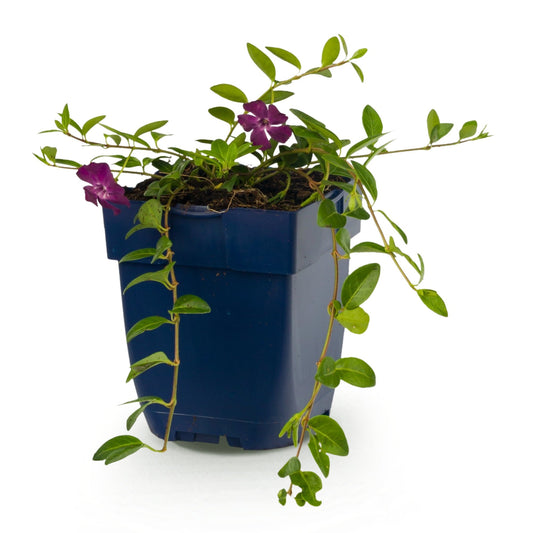
Lesser periwinkle ‘Atropurpurea’ (Vinca minor) – evergreen ground cover – 11 cm pot – height 15–25 cm
Regular price From 39,95 €Regular price39,95 €From 31,96 €Livraison offerte -


Ivy 'Glacier' (Hedera helix) - evergreen climber - 11 cm pot - Height 40 cm - Pack of 2
Regular price 39,95 €Regular price39,95 €31,96 €Livraison offerte -

 Livraison offerte
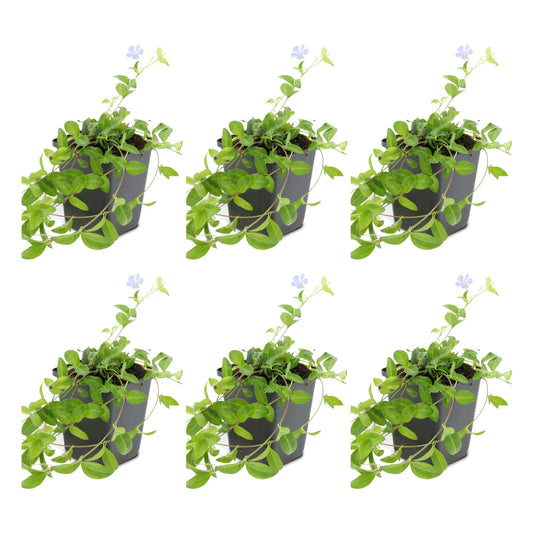
Lesser periwinkle (Vinca minor) - flowering evergreen groundcover
Regular price From 39,95 €Regular price39,95 €From 31,96 €Livraison offerte -

 Livraison offerte
Small periwinkle 'Alba' (Vinca minor) - white-flowered groundcover
Regular price From 54,95 €Regular price54,95 €From 43,96 €Livraison offerte -


Small periwinkle 'Argenteovariegata' (Vinca minor) - cream variegated foliage groundcover
Regular price From 34,95 €Regular price34,95 €From 27,96 €Livraison offerte -


Small periwinkle 'Gertrude Jekyll' (Vinca minor) - compact groundcover with white flowers
Regular price From 39,95 €Regular price39,95 €From 31,96 €Livraison offerte -

 Livraison offerte
Big periwinkle (Vinca major) - vigorous groundcover with blue flowers
Regular price From 39,95 €Regular price39,95 €From 31,96 €Livraison offerte


✂️ Periwinkle care: watering, pruning and control
Periwinkle care comes down to three things: water during the first year, cut it back in spring and trim anything that spreads beyond its boundaries. Once established, it generally gets by on rainfall, except in full sun or during a prolonged dry spell. The RHS recommends cutting it back hard in early spring: the carpet grows back denser, and you can keep its spread in check.
The RHS also notes that periwinkle can become invasive if left unchecked.
💧 Watering: Regularly during the first year, then only during drought or in sunny positions
✂️ Pruning: Cut the carpet back hard in early spring
🔹 Edges: Trim stems that grow beyond the area with secateurs or a spade
🔹 Weeding: Remove weeds while the carpet is still filling in
👀 Monitoring: Check the leaves for signs of rust and aphids
🍂 Pruning periwinkle and caring for it through the seasons
Prune periwinkle in early spring, just before new growth starts: this is when the RHS recommends cutting it back hard. Cut the longest stems back to ground level with secateurs or shears, or mow a large carpet with the mower set high. Throughout the year, remove stems that spread beyond the intended area before they take root.
Both periwinkles are evergreen and rated H6, or -20 to -15°C, so they can overwinter without protection in most parts of France. NC State Extension gives lesser periwinkle USDA Zones 4a to 9b and greater periwinkle Zones 7a to 9b, suggesting that greater periwinkle is slightly less tolerant of severe cold.
📅 Seasonal care calendar
| Season | Key task |
|---|---|
| 🌸 Spring | Cut back hard in early spring; plant, weed and enjoy the main flowering period |
| ☀️ Summer | Flowering continues; water young plants and trim the edges |
| 🍂 Autumn | Plant and divide; give the edges a final trim |
| ❄️ Winter | Evergreen carpet at rest; no protection needed in H6 regions |
🌱 Propagating periwinkle: division and cuttings
Periwinkle is so easy to propagate that it often does the job itself. The RHS recommends division or semi-ripe cuttings; NC State Extension lists division and stem cuttings. The easiest method is to lift a rooted clump or a section of stem that has already rooted at a node with a spade, then replant it elsewhere straight away and water it.
To take a cutting, cut a section of semi-ripe stem with a few nodes in summer, remove the lower leaves and insert it into a light potting mix kept moist, in the shade.
🐛 Common problems: causes and solutions
Periwinkle is robust: the RHS says it is generally free from pests but susceptible to rust. NC State Extension also reports a stem canker that causes entire patches of the carpet to dry out, as well as aphids, root-knot nematodes, root rot and leaf spots on greater periwinkle.
The same source notes that greater periwinkle can host the bacterium responsible for Pierce’s disease of grapevines: avoid planting it immediately next to a vineyard.
| Symptom | Likely cause | Solution |
|---|---|---|
| Orange or brown pustules on the undersides of leaves | 🍄 Rust | Remove and discard affected leaves; improve airflow through the carpet with spring pruning |
| Patches of stems turn brown and dry out | ☀️ Stem canker or blight (NC State) | Cut out affected areas back to healthy growth, disinfect tools, and avoid an overly dense, damp carpet |
| Colonies of insects on young shoots | 🐛 Aphids | Allow beneficial insects to do their work, cut off infested shoots or spray with water |
| Sparse foliage, few flowers | 🌱 Very dense shade or depleted soil | Cut back in spring, add compost and accept fewer flowers in shade |
| Leaves wilt and turn yellow in summer | 🌱 Very dry soil | Water during dry spells, mulch, and reserve full sun for moist soils |
| Carpet spreads into the lawn or flower beds | ⚠️ Stems root at the nodes | Trim the edges, pull out rooted stems and install underground edging |
-

Cover the ground with ease: our outdoor ground cover plants blanket slopes,...


🌿 Our recommendations for further reading
We don’t sell periwinkle, but our guides and collections can help you create a thriving ground cover in shade or sun.
| Our recommendations | Why choose them |
|---|---|
| Ground-cover perennials: a low-maintenance flower bed | A guide to choosing the right ground cover for your soil and aspect |
| Our ground-cover plants | Ground-cover alternatives for dressing the ground beneath trees and covering slopes |
| Our shade- and cool-loving plants | Perennials and shrubs that thrive in shade and cool conditions, to pair with the ground cover |
| Our perennials for flower beds | Perennials to add structure to a flower bed around the covered area |
🎨 Which plants to pair with periwinkle
Pair periwinkle with plants that are tall or vigorous enough not to be smothered by it. Under trees, it forms a green carpet at the base of shade-loving shrubs such as Fatsia japonica or tall clumps of Japanese anemones.
For varied textures, alternate it with carex, which also stay evergreen in the shade. In spring, naturalized daffodils emerge through the carpet and bloom alongside it. Against a shady wall, climbing ivy takes over vertically.
However, avoid mixing it with delicate, small perennials, which it will eventually smother; our guide to shade-loving perennials suggests other suitable companions.
⚠️ Is periwinkle toxic or invasive?
When it comes to toxicity, be cautious without being alarmist. The ASPCA's “periwinkle” entry (American Society for the Prevention of Cruelty to Animals) classifies the plant as toxic to dogs, cats, and horses due to periwinkle alkaloids (vinca alkaloids): vomiting, diarrhea, low blood pressure, lethargy, tremors, seizures, coma, and even death.
Important clarification: this entry is listed under Vinca rosea, a synonym of Catharanthus roseus according to POWO—that is, Madagascar periwinkle. It also mentions the common names “running myrtle” and “vinca,” which are sometimes used for lesser periwinkle, but it names neither Vinca minor nor Vinca major, so it does not allow us to draw conclusions about the garden periwinkles discussed here.
For Madagascar periwinkle itself, NC State Extension indicates low-severity toxicity across all parts of the plant, with problems occurring if large quantities are ingested. For Vinca minor and Vinca major, neither the RHS nor NC State Extension publishes a toxicity rating: do not eat them, use them for self-medication, or leave them within reach of animals that chew on plants.
As for their tendency to spread, the RHS warns that both species can become a nuisance if left unchecked.
In the United States, where they have been introduced, NC State Extension states that greater periwinkle is classified as invasive in several states, including California; for lesser periwinkle, the NC State Extension entry notes that it appears on many unwanted plant lists.
In France, POWO considers them native; we were unable to verify any regional list classifying them, so plant them well away from woodland and natural areas, and check with your regional botanical conservatory.
✅ Our expert tips for success
Growing periwinkle successfully comes down to a few simple rules: choose a clearly defined area, keep the soil moist but not waterlogged, water during the first year, and cut it back hard in early spring. Choose lesser periwinkle for a fine carpet under trees, greater periwinkle to cover a slope quickly, and cut back any growth that spreads beyond its bounds each year.
You’ll have green ground cover in every season, with blue-violet flowers in spring, where the lawn gives up.
Periwinkle is one of the first plants I recommend for the base of a tree where nothing else will grow, because it thrives where the lawn gives up. I always plant it against a clearly defined boundary, a path, or an edging, never in the middle of a bed of small perennials. Every spring, I cut it back hard, and I find the carpet looks all the better for it. And when someone asks me about “periwinkle” for a sunny balcony, I always check whether they actually mean Madagascar periwinkle.

Laura Bruneau
Jardinière et autrice