

Tradescantia (wandering Jew): care, propagation and varieties of the genus

To properly care for a Tradescantia, place it in bright, filtered light, water it when the top of the substrate has dried, and pinch its stems regularly to keep it bushy. Tradescantia, or spiderwort, includes trailing plants with striped, purple, pink, or velvety foliage: Tradescantia zebrina, Tradescantia pallida, Tradescantia fluminensis, and their varieties. They are among the easiest and fastest-growing houseplants to propagate.
Their only real drawback: they become sparse if left in the shade. This guide provides sourced care tips, explains the differences between species, helps diagnose problems, and introduces our varieties.
🌿 Why is spiderwort such a popular plant?
Its nickname spiderwort suggests a plant that grows almost without care; its popularity is mainly due to how easily it can be shared as cuttings. It offers rare colors for such a simple plant: silver and purple for zebrina, deep purple for pallida, and green, cream, and pink for recent selections.
NC State Extension notes that in bright light, zebrina's leaves seem to shimmer. Its rapid growth quickly rewards a good location, and every trim gives you enough to make new plants.
| Strength | What that means for you |
|---|---|
| Rare colors | Silver, purple, or pink foliage that stands out among classic green plants |
| Trailing habit | Flexible stems ideal for hanging baskets, high shelves, or the edge of a piece of furniture |
| Express propagation | A cut stem roots quickly in water or soil: the plant renews itself for free |
| Forgiving of neglect | Slightly fleshy leaves that tolerate missed watering better than overwatering |
🔎 Tradescantia ID card
The accepted genus is Tradescantia Ruppius ex L., from the Commelinaceae family, according to Plants of the World Online (Kew), which recognizes 86 species, all native to the New World.
Each species has its region: Tradescantia zebrina Regel comes from Mexico to Colombia, T. pallida (Rose) D.R.Hunt from Mexico, T. fluminensis Vell. from southeastern Brazil to northern Argentina. NC State Extension (North Carolina State University) gives zebrina about 15 to 23 cm in height and 30 to 60 cm in spread, and pallida about 30 cm in height and 30 to 60 cm in width.
| Criterion | Verified detail |
|---|---|
| 🏷️ Botanical name | Tradescantia Ruppius ex L. (spiderwort, dayflower); key species T. zebrina, T. pallida, T. fluminensis |
| 🧬 Family | Commelinaceae (Commelinaceae) |
| 🌳 Type | Perennial creepers or trailers, grown as houseplants in France |
| 🌍 Origin | Americas: from Mexico to Argentina depending on the species (Kew POWO) |
| 🍃 Foliage | Silver and green striped with purple undersides, purple, green, cream or pink variegated, sometimes velvety |
| 🌸 Flowering | Small white, pink, or mauve flowers with three petals; each flower lasts only one day |
| 📏 Size | About 15 to 30 cm tall, stems spreading 30 to 60 cm (NC State) |
| ⚠️ Toxicity | Sap irritates the skin; toxic to cats and dogs according to the ASPCA (T. fluminensis) |
📋 Quick care sheet
Essential care tips at a glance.
| Parameter | Guideline |
|---|---|
| Light | Bright and filtered, near an east or west window; a little gentle sun is acceptable |
| Watering | Moderate, when the top of the substrate has dried; significantly reduced in winter |
| Substrate | Well-draining indoor potting mix, pot with drainage holes |
| Humidity | Standard indoor air is tolerated; avoid placing directly next to a heater |
| Temperature | Minimum 5 to 10 °C (RHS, H1C); comfortable in a heated room |
| Repotting | In spring, when roots emerge from the pot, into a slightly larger pot |
| Fertilizer | Liquid fertilizer once a month during the growing season (RHS), nothing in winter |
| Toxicity | Irritating sap: gloves recommended; out of reach of cats and dogs |
| Difficulty | Very easy, provided it gets light and is pinched |
📍 Where to place spiderwort and when to set it up?
Spiderwort should be placed where the light is bright but filtered. The RHS recommends bright filtered light indoors for zebrina, and NC State Extension explains that low light causes zebrina to lose leaves and dull its colors, and stretches out Tradescantia spathacea, causing it to lose its purple hue.
Too little light results in long stems with widely spaced leaves and dull colors.
☀️ Ideal location: Near an east or west window, or set back from a south-facing window behind a sheer curtain. In a hanging basket, make sure the top of the plant receives light.
📅 When to set it up: In spring and summer, when growth resumes: this is the best time to repot, prune, and propagate.
🏡 Indoors or outdoors?: An indoor plant in France. The RHS classifies it as H1C: it can spend the summer outdoors in partial shade, but bring it in as soon as nights approach 10 °C.
🪴 Planting and repotting a Tradescantia
Tradescantia is not picky about the substrate, provided it drains well. The RHS recommends an indoor potting mix based on loam, without peat. NC State Extension notes that waterlogged soil causes roots and stems to rot: a pot with drainage holes and an empty saucer count for more than the mix itself.
Repot in spring, into a slightly wider pot, or replant cuttings in the same pot to fill in the center.
| Step | The right move |
|---|---|
| 1. Choose the pot | A pot with drainage holes or a hanging basket, slightly wider than the root ball |
| 2. Prepare the mix | Indoor potting mix, lightened with a handful of perlite if needed |
| 3. Place the root ball | At the same level as before, spreading the stems around the perimeter |
| 4. Fill in | Stick a few cuttings in the center if the plant is sparse |
| 5. Water | Water thoroughly, then empty the saucer |
columns: 4
columns_mobile: 2
-
 Sold out
-

 Sold out
-

 Sold out
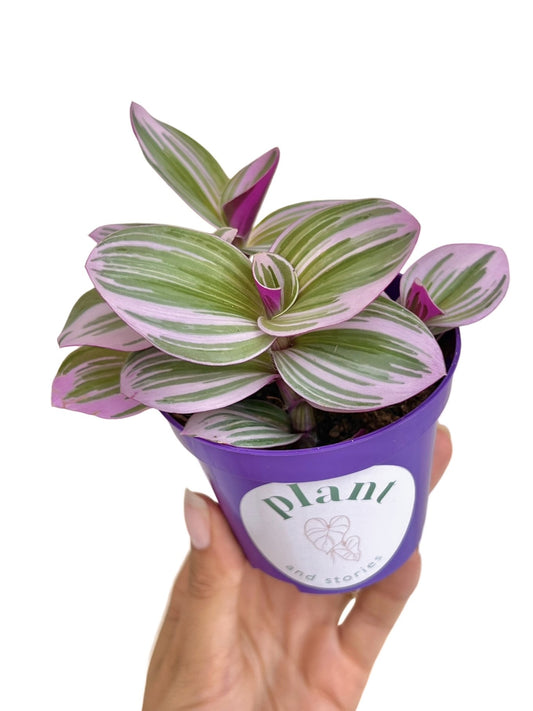
Tradescantia Unicorn
Regular price From 8,00 €Regular price8,00 €From 6,40 €Sold out -
-
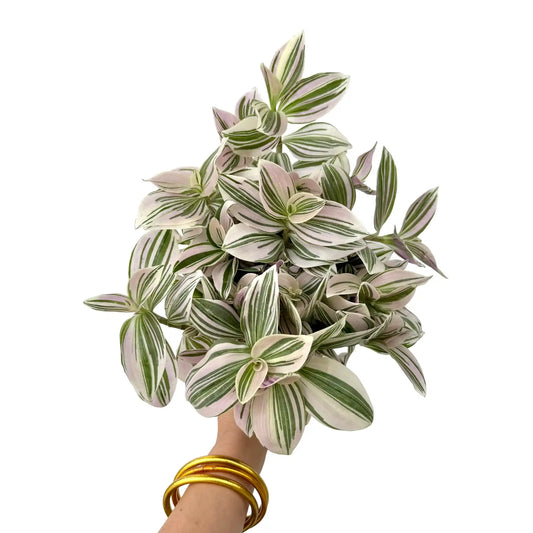
Tradescantia Zebrina Pink Paradise
Regular price 7,95 €Regular price7,95 €6,36 € -

 Sold out
Tradescantia Pallida
Regular price 12,95 €Regular price12,95 €10,36 €Sold out -

 Sold out
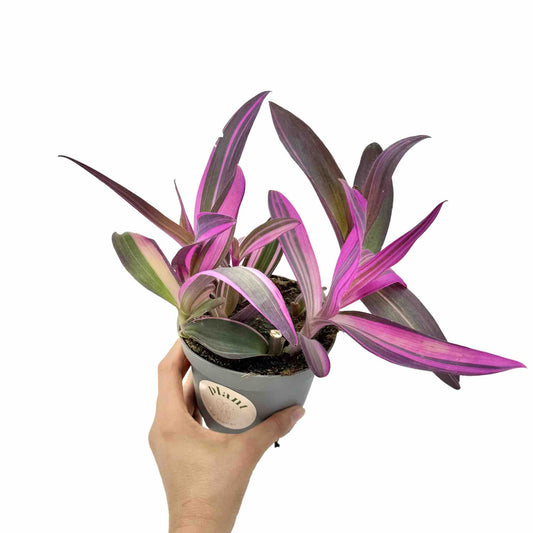
Tradescantia Pallida Purple Heart
Regular price 9,95 €Regular price19,95 €Sale price 9,95 €9,95 €7,96 €Sold out -
Trio Tradescantia Nanouk Tradescantia Unicorn Tradescantia Zebrina
Regular price 19,95 €Regular price24,00 €Sale price 19,95 €19,95 €15,96 €Sold out


✂️ Tradescantia care: watering, pinching, and colors
Spiderwort care relies on three actions: watering moderately, giving it light, and pinching it often. NC State Extension recommends watering regularly while allowing the substrate to dry between waterings, and notes that pruning keeps the plant compact while making the foliage denser.
For variegated forms, the RHS fact sheet also recommends pinching the tips and removing shoots that have turned completely green again.
💧 Watering: Water when the top of the substrate feels dry, then empty the saucer. In winter, water much less frequently: the plant grows little and is sensitive to overwatering.
🔹 Pinching: Cut the ends of stems just above a node as soon as they become leggy: each cut produces new branches, and the pieces become cuttings.
🔹 Return to green: Remove any stem at the base that has turned solid on a variegated variety, otherwise, more vigorous growth will take over.
🌱 Fertilizer: Liquid fertilizer for houseplants once a month during the growing season, as recommended by the RHS; nothing in winter.
💧 Humidity: Standard indoor air is suitable. If tips dry out near a heater, move the plant away or group it with other plants, without misting the foliage.
🍂 Spiderwort through the seasons
In spring, growth resumes: this is the time to repot, resume fertilizing, and prune stems that became leggy during the winter. In summer, the plant grows quickly and can go outdoors in partial shade if nights remain mild. For Tradescantia pallida, NC State Extension places flowering in summer and notes that it does not tolerate temperatures below 50 °F, or about 10 °C.
In autumn, bring it in and make backup cuttings. In winter, place it in the brightest spot and water less frequently.
📅 Seasonal care calendar
| Season | Key action |
|---|---|
| 🌸 Spring | Repotting, resuming fertilizer, pruning stems stretched during winter |
| ☀️ Summer | Regular watering, frequent pinching, possible outdoor placement in partial shade |
| 🍂 Autumn | Bring in before cool nights, backup cuttings, end fertilizer |
| ❄️ Winter | Brightest spot, spaced watering, no fertilizer |
🌱 Propagating Tradescantia: the express method
Cuttings are the best way to keep a dense spiderwort year after year. Cut the end of a stem just below a node, remove the lower leaves, then place it in a glass of water or stick it directly into moist substrate: the RHS recommends taking tip cuttings in spring or summer, rooted in water or potting mix.
NC State Extension notes that pallida is easiest to propagate with stem cuttings. To compare the two methods, read our guide on cuttings in water or potting mix. Plant several cuttings together in the same pot to quickly get a full plant.
🐛 Common problems: causes and solutions
Most Tradescantia problems come from light or water, rarely disease. The RHS lists spider mites, mealybugs, aphids, and thrips as pests; NC State Extension adds root and stem rot in waterlogged soil.
| Symptom | Probable cause | Solution |
|---|---|---|
| Long stems, widely spaced leaves | ☀️ Lack of light | Move the plant closer to the window, pinch, and propagate the leggy stems |
| Dull colors, disappearing variegation | ☀️ Insufficient light or new green growth | More filtered light, remove completely green stems |
| Sparse base, dry leaves in the center | ⚠️ Old plant or repeated thirst | Prune short, fill in with cuttings, water more regularly |
| Soft and black stems at the base | 🍄 Overwatering, rot | Cut off the healthy parts to propagate them, start over in well-draining substrate |
| Fine webs, speckled leaves | 🕷️ Spider mites (mites) | Shower the foliage, isolate the plant, treat early |
| White cottony clusters | 🐛 Mealybugs | Remove them with a cotton swab soaked in alcohol, check the leaf axils |


🌸 Our Tradescantia varieties
The genus is mainly sold under variety names. Here are the ones we offer, along with other species you will encounter in garden centers. For Nanouk, you can also find our dedicated care sheet.
| Variety | Its strength |
|---|---|
| Tradescantia zebrina | Zebra spiderwort: silver and green striped leaves, purple undersides; available in 'Pink Joy' and 'Pink Paradise' with pink highlights |
| Tradescantia pallida 'Purple Heart' | Purple spiderwort: intense purple stems and leaves, small pink flowers; see also Tradescantia pallida |
| Tradescantia 'Nanouk' | Dutch selection (2012 cross) linked by its patent to T. albiflora, a name Kew treats as a synonym of T. fluminensis: light purple, green, and grayish-green leaves |
| Tradescantia 'Unicorn' | Light green, cream, and pale pink striped foliage, for a luminous hanging basket |
| Tradescantia sillamontana 'Brown' | Mexican species with leaves up to about 5 cm, covered in cottony white hairs (NC State), to be watered sparingly |
| 'Purple Passion' | Velvety purple leaves. Caution: the same common name also refers to Gynura aurantiaca, an Asteraceae (UF IFAS), which is not a Tradescantia: rely on the Latin name on the label. |
🎨 What plants to pair with the inch plant?
The inch plant likes the same bright light and moderate watering as other easy trailing plants. For a cascading shelf display, pair it with the heart-of-Jesus vine (Ceropegia woodii), with its slender stems, or with Chlorophytum.
For a splash of color, place it near an Hypoestes or a Coleus, two plants that can be pinched and propagated by cuttings just like it. More ideas await you in our guide to plants with colorful foliage.
⚠️ Is Tradescantia toxic to cats, dogs and skin?
Yes, with a toxicity considered low but real. The ASPCA (American Society for the Prevention of Cruelty to Animals) classifies the species Tradescantia fluminensis as toxic to dogs, cats and horses, with dermatitis as a clinical sign; its fact sheet does not cover the other species.
For T. pallida, T. zebrina, T. sillamontana and T. spathacea, NC State Extension reports mouth and stomach irritation if ingested, and skin irritation upon contact with the sap. Wear gloves when pruning, as also recommended by the RHS, and hang the plant out of reach of animals.
For a risk-free green corner, see our non-toxic plants for dogs.
✅ Our expert tips for success
A beautiful Tradescantia is a luminous plant, pinched often and renewed without regret. Give it bright, filtered light, moderate watering, a heated room in winter, and cut back the stems that stretch out.
Keep up good habits: wear gloves when pruning, and never throw pruning waste in the garden, because the University of Florida (UF IFAS) classifies T. fluminensis as a category 1 invasive plant in Florida: it spreads by seeds and by stem fragments that root at the nodes.
I love the inch plant because it is the plant we share the most: a stem placed in a glass of water, and a friend leaves with their plant. At my place, it lives hanging near an east-facing window, and I pinch it every time I pass by with my scissors. When it gets bare in the center, I don't force it: I replant the cuttings in the same pot and it starts anew, even better.

Laura Bruneau
Jardinière et autrice


