How to care for an Anthurium Silver Blush?

CARE INSTRUCTIONS: ANTHURIUM SILVER BLUSH

Introduction
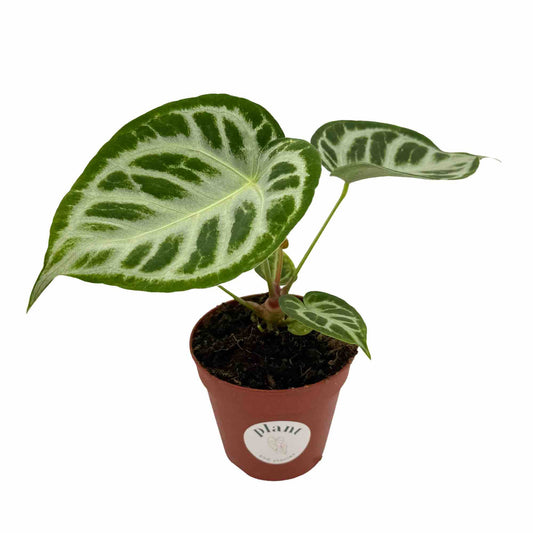
The Anthurium Silver Blush is a lush houseplant known for its silvery leaves marbled with green veins.
This plant adds a touch of elegance and exoticism to any interior.
Native to the tropical forests of Central and South America , the Anthurium Silver Blush requires special care to thrive indoors.
Features
- Common name: Anthurium Silver Blush
- Scientific name: Anthurium Silver Blush
- Family: Araceae
- Origin: Central and South America
- Flower color: White to pale pink, but not known for its beauty
- Flowering period: Year-round under ideal conditions
- Ideal temperature: 18-25°C
- Humidity: High
- Vegetation type: Perennial
- Foliage type: Evergreen
Did you know that?

The Anthurium Silver Blush is prized for its distinctively patterned leaves. The silver veins contrast beautifully with the dark green foliage, creating a stunning visual effect.
Have you ever seen its glitter in the light? :)
This plant is very often prized by lovers of rare and exotic plants because of its unique appearance!
HOW TO CARE FOR AN ANTHURIUM SILVER BLUSH? | IN BRIEF
Light :
Prefers bright but indirect light . Avoid direct sunlight which can damage and burn the delicate leaves.
Water :
Water when the soil is dry deep down .
If possible, use rainwater to avoid the accumulation of minerals that can cause spots on the leaves.
Avoid overwatering to prevent root rot.
Temperature :
Ideally between 18°C and 25°C. Avoid cold drafts and temperatures below 15°C.
Humidity :
Prefers high humidity. Mist the leaves regularly, especially in summer, or use a humidifier to maintain a relative humidity of 60% or more.
WHAT TYPE OF SOIL IS NEEDED FOR ANTHURIUM SILVER BLUSH?

Anthuriums, including the Anthurium Silver Blush, require a specific substrate to thrive.
They prefer well-drained , light and aerated soil that allows the roots to breathe while retaining sufficient moisture.
Good drainage is essential to prevent root rot, a common problem in Anthuriums.
A soil composed of specific elements is therefore essential .
We recommend using our " Special Anthurium" mix, which will perfectly meet its needs.
This mixture includes essential elements for its well-being and is enriched with fertilizer to nourish it sustainably.
An alternative to our professional and custom-made " Special Anthurium " mix is to use our "Araceae Substrate, also known as Monstera Soil".
It is a more generic but sufficiently draining substrate that can also meet the needs of Anthuriums.
WHEN SHOULD I REPOT MY PLANT?
Repot in the spring every two years or when the roots start to grow out of the current pot.
Repot in a pot with drainage holes, preferably transparent, to monitor and follow the development of the root system.
HOW TO MULTIPLY AN ANTHURIUM SILVER BLUSH?
Anthurium Silver Blush is propagated mainly by division .
The method: When repotting, carefully divide the plant into sections, each with several leaves and attached roots.
Replant the divisions in transparent pots with drainage holes, filled with sphagnum moss .
HOW TO PREVENT AND TREAT PESTS?
Inspect regularly for signs of scale insects, aphids, or spider mites.
In case of infestation, treat with natural and biological methods such as black soap.
Find our organic recipe for fighting pests on the product page of our black soap for plants .
For greater effectiveness, we recommend applying the solution with our pair of microfiber plant cleaning gloves .
It will allow you to gently eliminate unwanted elements.
IN SHORT, HERE IS OUR EXPERT ADVICE
- Provide moderate to bright indirect light for optimal growth.
- Maintain high humidity to prevent the leaves from drying out.
- Water regularly with filtered water, allowing the substrate to dry out between waterings.
- Repot every 2 years to ensure healthy growth.

Laura Bruneau
Jardinière & autrice