Horticultural charcoal: What is it used for in the garden?

Horticultural charcoal helps keep the growing medium clean and airy: its porous structure improves drainage, absorbs excess moisture and impurities, and helps the medium stay healthy, especially in enclosed environments such as terrariums. The rule is simple: add a few pieces to the mix or to the bottom of a pot without drainage holes, and never use barbecue charcoal. Find everything you need to create your growing mixes in our dedicated range.
This guide explains what horticultural charcoal is, what it’s really used for, how to use it in pots and terrariums, and why it shouldn’t be confused with cooking charcoal.
🌿 What is horticultural charcoal?
Horticultural charcoal is porous charcoal produced through pyrolysis: organic matter (often hardwood) is heated to a very high temperature (400 to 700 °C) without oxygen, leaving behind a stable substance rich in carbon (over 80% carbon). The same process produces biochar, which is used as a soil amendment.
According to NC State Extension, this type of charcoal is used as an amendment to improve the soil’s ability to retain water and nutrients. Its extremely porous structure, which can have an internal surface area of up to 500 m² per gram, creates tiny air pockets in the growing medium, allowing water and oxygen to circulate more freely. Its slightly alkaline pH is neutral for most plants.
Be careful not to confuse it with barbecue charcoal: the latter often contains additives, fire starters or ash that can damage roots. Always use untreated horticultural charcoal. There’s also activated charcoal, an even more porous version that’s superheated and has greater absorption capacity. It’s often used for water filtration, especially in terrariums and aquariums, while regular horticultural charcoal is perfectly suitable for amending a growing medium. For most indoor plant uses, ordinary horticultural charcoal works very well and costs less.
✅ What is horticultural charcoal used for?
Horticultural charcoal has three main functions: it improves drainage and aeration, absorbs certain impurities and odors, and helps keep the growing medium healthy. These benefits are especially valuable in enclosed environments.
Thanks to its pores, it prevents water from stagnating and reduces the risk of root suffocation. It also captures some excess mineral salts (useful in cases of over-fertilizing) and limits odors caused by decomposition. Finally, its porous surface provides a habitat for beneficial microorganisms in the growing medium.
| Function | Effect on the plant |
|---|---|
| Drainage / aeration | Prevents stagnant water and root suffocation |
| Absorption | Captures excess salts and impurities |
| Odor control | Limits unpleasant odors in enclosed environments |
| Microbial life | Provides a home for beneficial microorganisms |
I see horticultural charcoal as a little health insurance policy for the growing medium, especially in pots without drainage holes and in terrariums. It won’t work miracles, but it prevents a lot of problems with stagnant water and odors. My advice: don’t overdo it—a small amount is enough. After years of making my own mixes, it’s a modest ingredient I always keep on hand.
🪜 How to use horticultural charcoal in pots
In a standard pot, mix a small amount of horticultural charcoal into the growing medium to improve drainage and aeration: one part charcoal to about nine parts potting mix (5 to 10% of the total volume), in 3 to 10 mm pieces, is a common guideline. You can also add a thin layer to the bottom of the container.
It’s especially useful in pots without drainage holes, where water can’t drain away: a 1 to 2 cm layer at the bottom absorbs some of the excess and reduces the risk of root rot. You can combine it with other amendments, such as horticultural perlite, for an even airier growing medium.
columns: 4
columns_mobile: 2
-
Pon - Hydroponic mineral substrate for plants - Hydroponic plant cultivation
Regular price From 6,50 €Regular price6,50 €Sale price From 6,50 €6,50 €From 5,20 € -
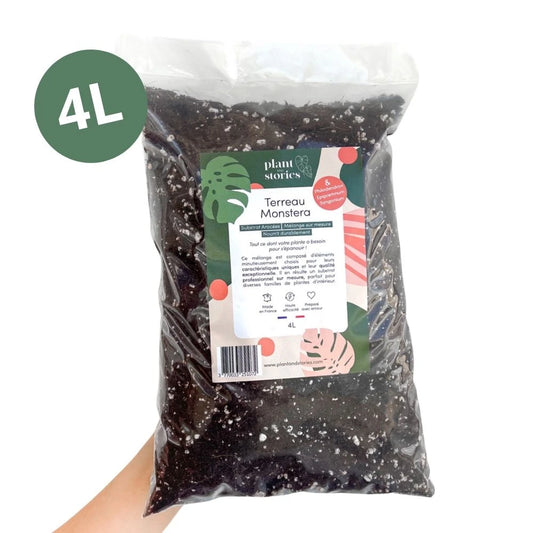
Monstera Soil - Enriched with Mycorrhiza and Bacillus - Araceae Substrate
Regular price From 9,50 €Regular price23,75 €Sale price From 9,50 €9,50 €From 7,60 €Sale -
Hoya Premium Potting Soil - Enriched with Mycorrhizae and Bacillus - Made in France
Regular price 11,99 €Regular price11,99 €Sale price 11,99 €11,99 €9,60 € -
Duo - Universal Substrate 10L + Universal Liquid Fertilizer 250ml + free graduated pipette
Regular price 32,00 €Regular price37,00 €Sale price 32,00 €32,00 €25,60 €Sale





🪴 Horticultural charcoal in terrariums
Horticultural charcoal works especially well in terrariums: in this humid, enclosed environment, it helps keep the water clean, control odors and prevent fungal growth. It’s typically placed between the drainage layer and the growing medium.
A terrarium is a closed system that doesn’t drain like a pot with drainage holes, so anything that helps keep the water clean is valuable. Charcoal captures some impurities and provides a surface for beneficial bacteria to grow, helping balance the micro-ecosystem. That’s why it appears in almost every terrarium-building tutorial: without it, stagnant water at the bottom often starts to smell and encourages mold—two common problems in these little enclosed worlds.
| Terrarium layer | Purpose |
|---|---|
| Clay pebbles / gravel | Drainage and a water reservoir at the bottom |
| Horticultural charcoal | Keeps the water clean and helps control odors and fungi |
| Growing medium | Nourishes and anchors the roots |
| Decor (moss, bark) | Appearance and microclimate |
👍 Which plants and situations benefit most?
Horticultural charcoal isn’t essential everywhere, but it can make a real difference in certain situations. Knowing when to use it helps avoid adding it unnecessarily.
It’s especially useful in containers without drainage, closed terrariums, mixes for orchids and aroids, and anywhere you want to limit stagnant water. For a plant in a pot with drainage holes and a well-draining mix, it’s a bonus, but less essential.
| Situation | Benefit of charcoal |
|---|---|
| Pot without drainage holes | High: absorbs excess water |
| Closed terrarium | High: keeps things clean and helps control odors |
| Orchid / aroid mix | Useful: improves aeration |
| Pot with drainage holes, well-draining mix | Moderate benefit |
📝 How to prepare and measure horticultural charcoal
Horticultural charcoal requires no complicated preparation: just measure it according to how you plan to use it. The golden rule is moderation, as it’s an addition, not the base of the growing medium.
For a potting mix, aim for about one part charcoal to nine parts growing medium. For a bottom layer in a pot without drainage holes or in a terrarium, a thin layer 1 to 2 cm deep is enough. It pairs well with perlite, bark and clay pebbles to create a living, airy growing medium. There’s no need to add more often: unlike fertilizer, it lasts a long time and only needs replacing after about 12 to 24 months.
📋 Quick reference (for experienced gardeners)
Horticultural charcoal guidelines at a glance.
| Parameter | Guideline |
|---|---|
| Type | Porous charcoal (pyrolysis) |
| Don’t confuse with | Barbecue charcoal (additives) |
| Functions | Drainage, absorption, odor control |
| Proportion in pots | ~1 part to 9 parts growing medium |
| Ideal for | Pots without drainage holes, terrariums |
| Placement in terrariums | Between drainage and growing medium |
| Bonus | Provides a home for beneficial microorganisms |
| Limitation | Moderate effect; not a fertilizer |
| Use | Suggested amount |
|---|---|
| Potting mix | ~1 part to 9 parts growing medium |
| Bottom layer (pot without drainage holes) | 1 to 2 cm deep |
| Terrarium | Thin layer between drainage and growing medium |
⚖️ Horticultural charcoal and biochar: what’s the difference?
Horticultural charcoal and biochar are very similar: both are produced by pyrolyzing organic matter. The difference lies mainly in their intended use and preparation.
Biochar is designed as a permanent soil amendment to improve the soil’s ability to retain water and nutrients over the long term, as described by Oregon State University Extension. Horticultural charcoal, on the other hand, is used mainly in pots and terrariums to improve drainage and keep the growing medium clean. In practice, the two are largely interchangeable for your indoor plants.
| Aspect | Horticultural charcoal | Biochar |
|---|---|---|
| Main use | Pots, terrariums | Soil amendment |
| Form | Chunks | Often powder / granules |
| Purpose | Drainage, keeping the growing medium clean | Long-term soil fertility |


🩺 Troubleshooting: using horticultural charcoal correctly
A few simple mistakes can limit its effectiveness. Here’s how to avoid them.
| Mistake | Consequence and solution |
|---|---|
| Barbecue charcoal | Toxic additives: use horticultural charcoal |
| Using too much | Unbalanced growing medium: a small amount is enough |
| Expecting it to work as fertilizer | Charcoal is not a fertilizer |
| Forgetting drainage | Charcoal alone can’t replace drainage holes |
To create your own mixes, our range of potting mixes and growing media and our amendments can help you create the ideal environment.
💚 Healthy growing media with Plant and Stories
Horticultural charcoal is a modest but useful ally: it aerates the growing medium, keeps it clean and helps keep the water clean, especially in pots without drainage holes and in terrariums. Used in small quantities and never confused with cooking charcoal, it’s an ideal addition to a good growing medium.
To learn more, explore our specialty growing media and horticultural perlite, carefully selected in France. Used in the right amount, this modest ingredient helps promote healthy roots and keeps the growing medium healthy for longer.