Bougainvillea: Growing in Pots, Winter Care, and Pruning

To grow bougainvillea successfully, place it in full sun in a well-drained pot, let the growing medium dry out between waterings, feed it in summer, then protect it from frost from autumn onward: according to the RHS (Royal Horticultural Society), it needs nighttime temperatures of at least 10 °C in winter to keep its leaves.
Bougainvillea, the genus Bougainvillea, comprises thorny vines from South America whose brilliant colors come from bracts, not petals. This guide covers choosing a species, growing it in a pot, overwintering, pruning, taking cuttings, and why it may not flower, with information checked against Kew, the RHS, and several American universities.
To see how bougainvillea fits in with other sun-loving plants, consult our complete guide to Mediterranean plants and, for training plants, our complete guide to climbing plants.
🌿 Why grow bougainvillea, and which species to choose
From summer through autumn, bougainvillea provides a mass of color few climbing plants can rival: magenta, red, pink, orange, white, or yellow.
According to North Carolina State University Extension (NC State Extension), its true flowers are small, tubular, and usually white, grouped in threes at the center of brightly colored bracts; this is why its “bloom” lasts so long. Three groups dominate the market.
Bougainvillea glabra, along with the hybrids × buttiana, is recommended by the RHS (Royal Horticultural Society) for growing in pots because it flowers at a young age.
Bougainvillea spectabilis is more vigorous, while Bougainvillea × buttiana hybrids offer a variety of colors, including 'Poulton's Special' with magenta-pink bracts, 'Raspberry Ice' with cream-edged leaves, and 'African Sunset' with orange bracts, as cited by the RHS. University of Florida Extension (UF/IFAS) also mentions 'Barbara Karst', red and almost everblooming, and 'Sweet Dream', which is thornless.
The “Bougainvillea of Mèze” or “Mèze violet,” much sought after in France, is a trade name that nurseries describe as more cold-hardy: none of our authoritative sources document it, so we do not assign it a frost-tolerance threshold.
| Benefit | What it means for you |
|---|---|
| Long-lasting color | Colorful bracts from summer through autumn, remaining decorative much longer than a flower |
| Ideal for pots | A snug pot encourages flowering, and the plant is easy to bring indoors for winter |
| Heat tolerant | Tolerant of drought, heat, and salt once established, according to NC State Extension |
| Versatile forms | Can be grown on a trellis, espaliered, trained as a standard, or in a hanging basket, according to the Missouri Botanical Garden |
🔎 Bougainvillea at a glance
According to Plants of the World Online (POWO) from the Royal Botanic Gardens, Kew, the genus Bougainvillea Comm. ex Juss., published in 1789, comprises 17 accepted species native to South America (Argentina, Bolivia, Brazil, Ecuador, Paraguay, and Peru); it has since been introduced to many warm regions, including the Mediterranean basin.
Sources do not agree on the number of species: 18 according to NC State Extension, and 14 according to the Missouri Botanical Garden, which notes that the name honors the navigator Louis Antoine de Bougainville (1729–1811).
According to the RHS profile for Bougainvillea glabra, Bougainvillea glabra is a semi-evergreen, scrambling shrub from Brazil, with oval leaves up to 13 cm long, reaching 4 to 8 m tall and 2.5 to 4 m wide in 5 to 10 years. The NC State profile for Bougainvillea glabra gives its native range as Brazil and Peru and its hardiness as USDA zones 9a to 11b, while the profile for Bougainvillea spectabilis places B. spectabilis in zones 9b to 11b.
| Characteristic | Verified details |
|---|---|
| 🏷️ Botanical name | Bougainvillea Comm. ex Juss.; cultivated species include B. glabra, B. spectabilis, and B. × buttiana hybrids |
| 🧬 Family | Nyctaginaceae, the family of the four o'clock flower |
| 🌳 Type | Woody vine or scrambling shrub, with curved thorns that help it cling |
| 🌍 Origin | South America (POWO); B. glabra is native to Brazil and Peru (NC State) |
| ❄️ Hardiness | B. glabra: H1c, 5 to 10 °C (RHS); USDA zones 9a to 11b (NC State); protect from frost in winter |
| 🍃 Foliage | Evergreen to semi-evergreen, with simple oval leaves, sometimes variegated |
| 🌸 Blooming | Summer to autumn: magenta, red, pink, orange, white, or yellow bracts |
| 📏 Mature size | 4 to 8 m tall in favorable conditions (RHS); much smaller in a pot |
📋 Quick growing guide
Essential growing information at a glance.
| Factor | Guideline |
|---|---|
| Exposure | Full sun, at least 6 hours; light shade tolerated (Missouri), but with fewer flowers |
| Soil | Well-drained, preferably acidic; chlorosis may occur in alkaline soil (NC State) |
| Hardiness | Not hardy: H1c for B. glabra (RHS); nighttime minimum of 10 °C to retain leaves |
| Watering | Water thoroughly, then let the growing medium dry out between waterings; water very sparingly in winter |
| Planting | In spring; move outdoors at the end of May, after the last frosts (Missouri) |
| Pruning | At the end of winter, before new growth begins; cut long shoots back by half after the bracts fall (RHS) |
| Blooming | Summer to autumn, on the current year's growth |
| Care | Moderate: training, fertilizer during the growing season, and mandatory overwintering outside mild climates |
| Toxicity | No information verified by an authoritative source; thorns can cause injury, so wear thick gloves |
📍 Where and when to plant bougainvillea
Place bougainvillea in the sunniest spot available: North Carolina State University Extension (NC State Extension) recommends at least 6 hours of direct sunlight, while University of Arkansas Cooperative Extension recommends 6 to 8 hours for abundant blooms.
Against a south- or west-facing wall, it benefits from reflected heat. Move the pot outdoors only once all risk of frost has passed: the Missouri Botanical Garden recommends late May in a continental climate.
Growing it in the ground is only an option where winters are very mild, since the RHS rates it H1c and NC State places it in USDA zones 9 to 11; elsewhere in France, particularly Brittany and the east, grow it in a pot.
☀️ Ideal: A south- or west-facing terrace or wall, sheltered from the wind, with a trellis or taut wires
🪴 In a pot: Outdoors in the sun from late May to autumn, then brought under cover, frost-free, for winter
🚫 Avoid: Shade (few or no bracts), an oversized pot, a saucer full of water, and planting in the ground where it freezes
🪴 Planting bougainvillea in a pot or in the ground
Above all, bougainvillea needs a growing medium that drains well: Mississippi State University Extension emphasizes well-drained soil to prevent root rot.
For repotting, the RHS recommends a peat-free, loam-based compost such as John Innes No. 3 in early spring.
A Mediterranean-plant potting mix lightened with a little sand or pumice works well; there is no need to use pure ericaceous compost: NC State Extension and the Missouri Botanical Garden recommend well-drained, preferably acidic soil. Handle the stems with thick gloves: their thorns are long and fine.
Install the support at the same time as the root ball, as the plant does not twine by itself.
| Step | What to do |
|---|---|
| 1. Choose the right time | In spring, after the last frosts, in mild weather |
| 2. Prepare the container | A pot with drainage holes, just slightly wider than the root ball; do not leave water in the saucer |
| 3. Prepare the growing medium | Well-draining, loam-based mix, lightened with sand or pumice |
| 4. Position the root ball and support | Keep the root ball at the same level as before; install a sturdy trellis or stake straight away |
| 5. Water | Water thoroughly after planting, then wait for the surface of the growing medium to dry |
columns: 4
columns_mobile: 2
-

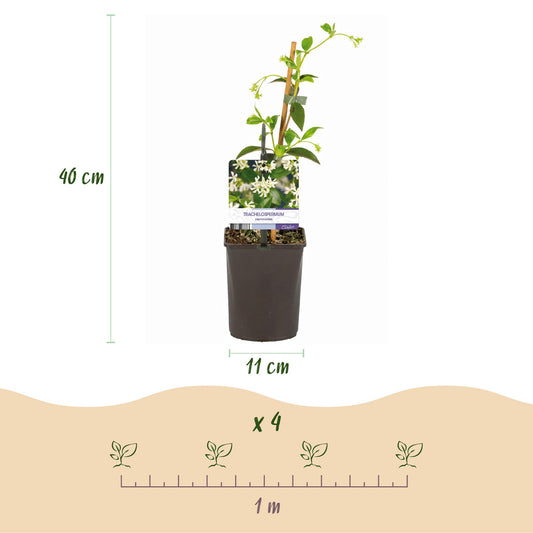
Star Jasmine (Trachelospermum jasminoides) - fragrant evergreen climber - 9 cm pot - Height 35 cm - Pack of 2
Regular price 39,95 €Regular price39,95 €31,96 €Livraison offerte -

 Livraison offerte
Passionflower (Passiflora) – flowering climber – 9 cm pot – 35 cm tall
Regular price From 39,95 €Regular price39,95 €From 31,96 €Livraison offerte -

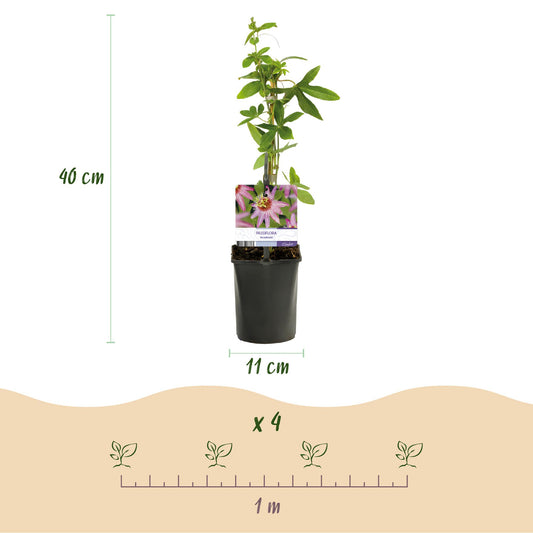
'Anastasia' Passionflower (Passiflora) – flowering climbing plant – 11 cm pot – 40 cm tall – Set of 2
Regular price 39,95 €Regular price39,95 €31,96 €Livraison offerte -
Olive (Olea europaea), Mediterranean ornamental shrub, 19 cm pot, Height 90 cm
Regular price 69,95 €Regular price69,95 €55,96 €Livraison offerte -


Ceanothus Victoria (Ceanothus), flowering Mediterranean shrub, purple flowers, 19 cm pot, Height 90 cm
Regular price 69,95 €Regular price69,95 €55,96 €Livraison offerte -


Agapanthus 'Albus' (Agapanthus africanus) - flowering perennial - 11 cm pot - Height 25 cm
Regular price From 39,95 €Regular price39,95 €From 31,96 €Livraison offerte -

 Livraison offerte
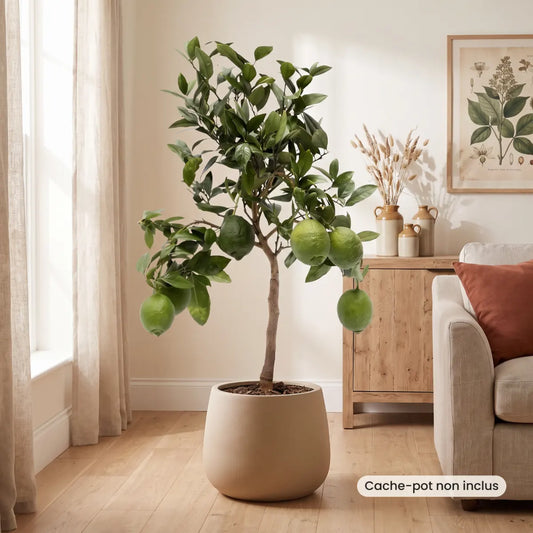
Citrus limon - Potted indoor lemon tree - 22cm pot - Height 80cm
Regular price 109,95 €Regular price109,95 €87,96 €Livraison offerte -
Eucalyptus (Eucalyptus gunnii) - ornamental shrub - 17 cm pot - Height 40 cm
Regular price From 94,95 €Regular price94,95 €From 75,96 €Livraison offerte


✂️ Bougainvillea care: watering, fertilizer, and training
Caring for bougainvillea means striking a balance: water and fertilizer while it is growing, but not too much. In spring and summer, the RHS recommends watering generously and applying a nitrogen-rich liquid fertilizer weekly, then switching to a potassium-rich fertilizer as soon as the bracts begin to color.
NC State Extension recommends watering deeply, then letting the growing medium dry out between waterings; University of Arkansas adds that bougainvillea hates wet feet and that too much fertilizer encourages leaves at the expense of flowers. For training, the RHS recommends bending and tying vigorous young side shoots early in the season: positioning them horizontally encourages bract formation.
💧 Summer watering: Water deeply, then let the growing medium dry out; never leave standing water
🌱 Fertilizer: Weekly while growing: nitrogen in spring, potassium as soon as the bracts start to color (RHS)
🧗 Training: Bend side shoots and tie them horizontally to a trellis or wires
🧹 Tidying: Remove faded bracts and poorly positioned shoots after each flush of bloom
👀 Check for: On the undersides of the leaves: whiteflies, scale insects, aphids, and mites
🍂 Overwintering and pruning bougainvillea
Overwintering determines whether a potted bougainvillea survives. Bring it indoors before the first frosts and choose one of two options. First, in a cool greenhouse, conservatory, or very bright room: the RHS specifies a nighttime minimum of 10 °C to prevent leaf drop, with watering less often but thoroughly from November onward and no more fertilizer.
Second, allow it to rest: the Missouri Botanical Garden explains that a cool dormant period is essential in winter; the leaves fall and watering should be sparing. University of Arkansas overwinter its pots this way in a frost-free space, keeping the growing medium slightly moist but never waterlogged, and leaving them unpruned. From March, give it a warm, bright spot again, then prune.
The RHS recommends pruning at the end of winter or in early spring, just before new growth begins, and cutting long shoots back by half once the bracts have fallen. It flowers on new wood: Arkansas even recommends repotting and pruning hard after a cool, dormant overwintering period.
📅 Seasonal care calendar
| Season | Key task |
|---|---|
| 🌸 Spring | Prune before new growth begins, repot if needed, return to a bright spot from March, move outdoors in late May after the frosts |
| ☀️ Summer | Full sun, water thoroughly then let the medium dry, weekly fertilizer (nitrogen, then potassium), train the shoots |
| 🍂 Autumn | Light pruning after flowering, stop fertilizing, water less, bring indoors before the first frosts |
| ❄️ Winter | Keep frost-free: in a bright spot at a nighttime minimum of 10 °C, or cool and dormant without leaves, with the growing medium barely moist |
🌱 Taking cuttings and propagating bougainvillea
Taking cuttings is the easiest method. According to the RHS, take semi-ripe cuttings with a heel in summer—that is, a small piece of bark from the main stem torn off with the cutting.
Remove the lower leaves and plant the cuttings in a light, free-draining mix, keeping them in a bright spot out of direct sun: they root in 4 to 6 weeks, faster with bottom heat of 15 °C. NC State Extension also mentions sowing seeds, but seedlings do not come true to the cultivars. Wear gloves: the thorns make handling the stems difficult.
🐛 Common problems: causes and solutions
Bougainvillea is generally a hardy plant: the RHS mainly lists whiteflies, mealybugs, aphids, and mites (red spider mites), while the Missouri Botanical Garden also mentions armored scale. For scale insects, see our natural treatments for mealybugs. However, the most common problems are caused by growing conditions: too little sun, too much water or fertilizer, or cold.
In alkaline soil or water, NC State Extension and UF/IFAS report chlorosis, a deficiency-related yellowing of the leaves.
| Symptom | Likely cause | Solution |
|---|---|---|
| Few or no bracts | 💧 Shade, too much fertilizer or water (UF/IFAS), pot too large (Arkansas) | Full sun, hold back on watering, moderate fertilizer, a snugger pot |
| Bracts drop quickly | ⚠️ Cool, damp weather (University of Arkansas) | Shelter from rain, space out watering; warmer weather encourages flowering |
| Leaves fall in winter | ⚠️ Nights below 10 °C (RHS) or normal dormancy in cool conditions (Missouri) | Move to a warmer, brighter room, or let it rest and wait until spring |
| Yellow leaves with green veins | 🌱 Chlorosis in alkaline soil or water (NC State, UF/IFAS) | Neutral to acidic potting mix, rainwater, fertilizer with trace elements |
| Sticky leaves, tiny white flies | 🐛 Whiteflies or aphids | Rinse the foliage, isolate the plant, use a suitable insecticide if needed |
| Cottony clusters, fine webbing | 🐛 Mealybugs or spider mites, especially during winter storage | Remove with a cotton swab dipped in alcohol, improve ventilation, shower the foliage |
-

Clematis, wisteria, passionflowers, climbing roses and star jasmine to adorn walls, pergolas...


🌿 Our picks for further reading
We don’t currently offer bougainvillea in our shop. To create a Mediterranean-style terrace or cover a sunny wall in the same spirit, explore our guides and collections.
| Our picks | Why choose them |
|---|---|
| Mediterranean plants: the complete guide | A guide to sun- and drought-loving plants, from olive trees to ceanothus |
| Climbing plants: the complete guide | All kinds of climbers, hardy or not, and how to train them |
| Mediterranean plants | Mediterranean plants to pair with a potted bougainvillea |
| Plants for balconies and terraces | Plants for pots and planters on a sunny terrace |
🎨 Which plants to pair with bougainvillea
Pair bougainvillea with plants that share its love of sun and dry soil.
In pots on the terrace, a potted lemon tree, oleander or dipladenia (Mandevilla) create a Mediterranean display that can be brought indoors at the same time.
Against a wall, our guide to star jasmine features an evergreen climber that stays outdoors in winter, while trumpet vine (Campsis) offers hardy summer blooms.
For a dry garden bed, take inspiration from our guide Mediterranean garden: how to create a garden bed or from the crape myrtle (Lagerstroemia).
Also explore our climbers to pair with Bougainvillea and our guide Plants for balconies and terraces: which should you choose?.
⚠️ Is bougainvillea toxic?
The real danger posed by bougainvillea is its thorns. NC State Extension describes long, slender thorns at the leaf axils and advises against planting it near busy walkways; UF/IFAS recommends wearing thick, long-sleeved gloves when handling it.
As for toxicity itself, the NC State, RHS and Missouri guides we consulted provide no information, and we were unable to verify an ASPCA (American Society for the Prevention of Cruelty to Animals) entry: we therefore cannot say that it is either toxic or safe for dogs and cats.
As a precaution, keep it out of reach of pets that chew plants and young children, and contact a poison control center or your veterinarian if it is ingested.
✅ Our expert tips for success
Success with bougainvillea comes down to four rules: at least 6 hours of full sun a day, a snug, well-draining pot, generous watering followed by a dry spell, and a frost-free winter. Feed it with a nitrogen-rich fertilizer in spring, then switch to one rich in potash as soon as the bracts begin to color; train its shoots horizontally and prune it in late winter.
In winter, keep it in a bright spot where nighttime temperatures stay above 10 °C, or let it rest in a cool place without leaves: it will flower again on new growth in summer. To prepare for the cold season, see our guide to protecting your plants from frost.
Bougainvillea is the plant that makes you dream of the Mediterranean, and I understand why people fall for it at the garden center. My advice is not to repot it into an oversized container as soon as you buy it: that’s often when flowering stops. I also warn people that it can look dead in late winter when it’s simply resting. And I always prune it with good gloves—its thorns don’t forgive.

Laura Bruneau
Jardinière et autrice