Plumbago (Plumbago auriculata): growing, pruning and overwintering

To grow plumbago successfully, plant it in full sun against a sheltered wall, in well-drained soil; train its flexible stems, water generously while it is growing, and protect it from frost from autumn onward: it is frost-tender, with an RHS hardiness rating of H2.
Cape plumbago, also known as Cape leadwort (Plumbago auriculata, long sold under the name Plumbago capensis), is a scrambling shrub from southern Africa whose sky-blue clusters bloom repeatedly all summer. It is not a true climber: it does not cling on its own and must be tied in.
This article complements our guide to Mediterranean plants: it brings together information verified against the RHS, Kew, NC State, the Missouri Botanical Garden and Trees and Shrubs Online, from frost tolerance to pruning.
🌿 Why grow Cape plumbago?
Plumbago brings one of the garden’s rare light-blue blooms to summer gardens and patios. According to North Carolina State University Extension (NC State Extension), its flowers appear on the current year’s growth from summer to autumn, and the shrub tolerates heat, drought and salt once established.
The RHS has awarded it its Award of Garden Merit and recommends it for courtyards and urban gardens, Mediterranean gardens, patios, containers and against walls.
Finally, Trees and Shrubs Online, the International Dendrology Society’s dendrological encyclopedia notes that it suckers from the base and readily regrows after pruning: a plant that forgives hard cuts.
| Benefit | What this means for you |
|---|---|
| Sky blue from summer to autumn | Clusters keep appearing on the current year’s growth (NC State) |
| Easy to train | Trained fan-wise against a wall, grown as a free-standing shrub or in a large pot |
| Heat tolerant | Tolerates heat, drought and salt once established (NC State) |
| Regrows after pruning | Suckers and readily shoots back when cut back (Trees and Shrubs Online) |
🔎 Plumbago at a glance
According to Plants of the World Online (POWO), the Royal Botanic Gardens, Kew database, Plumbago auriculata Lam. was described in 1786; it is a scrambling shrub from the subtropical biome, native from Mozambique to southern Africa (the Cape provinces, Free State, KwaZulu-Natal and the Northern provinces).
Kew records it as introduced in around 40 territories, including Spain, the Balearic Islands, Italy, Sicily, Greece, Crete, Portugal, Madeira, the Canary Islands and Tunisia; mainland France is not on this list. The database lists 7 synonyms, including Plumbago capensis.
According to Trees and Shrubs Online, the epithet “auriculata” refers to the small rounded auricles at the base of the leaves, and the species was certainly being grown in Europe by the early 19th century.
| Feature | Verified details |
|---|---|
| 🏷️ Botanical name | Plumbago auriculata Lam. (syn. Plumbago capensis), Cape plumbago, Cape leadwort |
| 🧬 Family | Plumbaginaceae |
| 🌳 Type | Evergreen shrub with scrambling stems, climbs by leaning on supports and needs training |
| 🌍 Origin | From Mozambique to southern Africa (POWO) |
| ❄️ Hardiness | H2 according to the RHS (1 to 5 °C, does not survive frost); USDA zones 9a to 11b (NC State) |
| 🍃 Foliage | Evergreen, light green, spatula-shaped leaves about 5 cm long with basal auricles |
| 🌸 Flowering | Terminal sky-blue clusters, flowers with a long tube and a diameter of 15 mm (RHS), summer to autumn |
| 📏 Mature size | 2.5 to 4 m tall with support, 1 to 1.5 m wide in 5 to 10 years (RHS) |
📋 Quick growing guide
The essential growing information, all in one place.
| Parameter | Guideline |
|---|---|
| Position | Full sun, south-, west- or east-facing, sheltered position (RHS) |
| Soil | Chalk, loam or sand, well drained, acidic, neutral or alkaline (RHS) |
| Hardiness | H2 (RHS): no frost; planting in the ground is only suitable for very mild areas |
| Watering | Generously while growing; keep soil barely moist during dormancy (RHS) |
| Planting | In spring, once all risk of frost has passed |
| Pruning | Late winter or early spring: cut side shoots back to 3 or 4 buds (RHS) |
| Flowering | From summer to autumn, on the current year’s growth (NC State) |
| Maintenance | Moderate: training, annual pruning, and frost-free winter protection in a pot |
| Toxicity | Skin irritant (plumbagin); harmful to animals if ingested (RHS) |
📍 Where and when to plant plumbago
Plant plumbago in full sun: the RHS Plumbago auriculata profile (Royal Horticultural Society) recommends a south-, west- or east-facing, sheltered position, in well-drained chalk, loam or sandy soil, whatever the pH.
NC State also accepts partial shade (2 to 6 hours of direct sun), but it performs best in full sun on our patios.
The real question is climate: Trees and Shrubs Online says it is killed by penetrating cold and survives outdoors only in mild, sheltered coastal locations, citing western France, south-west England and urban heat islands.
Elsewhere, grow it in a large pot, like bougainvillea, and bring it indoors before the first frosts. Plant it or move it outdoors in spring, once the frosts have passed.
☀️ Ideal: Sheltered south- or west-facing wall, warm patio, mild coastal garden or urban courtyard
🗓️ Timing: In spring, after the last frosts; bring pots indoors before the first autumn frost (Missouri)
🚫 Avoid: Windy or frost-prone locations, heavy waterlogged soil, or leaving an unprotected pot outdoors over winter
🪴 Planting and training plumbago, in the ground or in a pot
Plumbago does not cling on its own: NC State notes that it can be grown as a vine if its arching branches are given support, and the RHS says it can reach 4 m or more with support. So put up a trellis or tensioned wires before planting, then tie the stems in a fan shape as they grow.
For container plants, the RHS recommends a loam-based, peat-free potting mix in a bright position.
The Missouri Botanical Garden, where container growing is the norm, reports annual growth of 1 to 3 feet (about 30 to 90 cm) in its climate, and says regular pruning keeps plants more compact in containers—well short of the 6 to 7 feet tall and 8 to 10 feet wide (about 1.8 to 2.1 m and 2.4 to 3 m) they reach in their natural habitat.
| Step | What to do |
|---|---|
| 1. Choose a support | Trellis, wire mesh or tensioned wires against a sunny, sheltered wall |
| 2. Ensure good drainage | Free-draining soil in the ground; in a pot, use a loam-based, peat-free mix (RHS) |
| 3. Plant | Plant in spring, when frost has passed, with the crown level with the soil; firm well |
| 4. Train | Tie flexible stems in a fan shape with broad ties, without tightening them |
| 5. Water | Water thoroughly at planting, then regularly while the plant is growing |
columns: 4
columns_mobile: 2
-

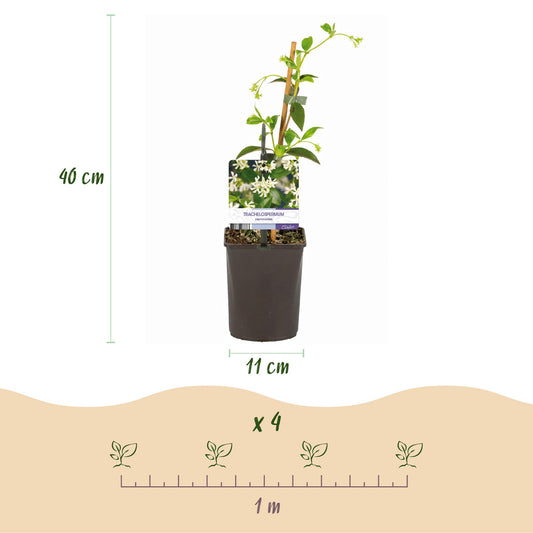
Star Jasmine (Trachelospermum jasminoides) - fragrant evergreen climber - 9 cm pot - Height 35 cm - Pack of 2
Regular price 39,95 €Regular price39,95 €31,96 €Livraison offerte -

 Livraison offerte
Blue passionflower (Passiflora caerulea) – exotic flowering climber
Regular price From 54,95 €Regular price54,95 €From 43,96 €Livraison offerte -
‘Constance Eliott’ Passionflower (Passiflora caerulea) – exotic flowering climber
Regular price From 39,95 €Regular price39,95 €From 31,96 €Livraison offerte -

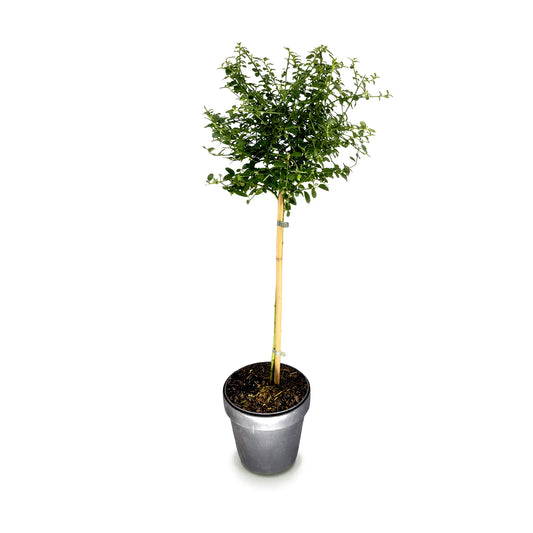
Ceanothus Repens (Ceanothus), flowering Mediterranean shrub, light blue flowers, 19 cm pot, Height 90 cm
Regular price 69,95 €Regular price69,95 €55,96 €Livraison offerte -

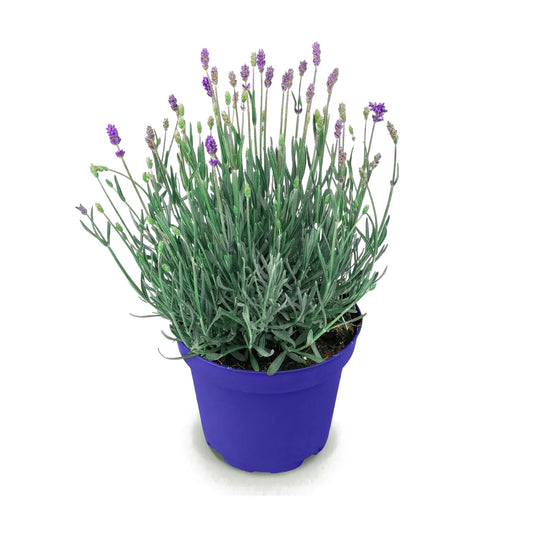
Lavender 'Hidcote' (Lavandula angustifolia) - fragrant honey-producing perennial - 12 cm pot - Height 25 cm
Regular price From 34,95 €Regular price34,95 €From 27,96 €Livraison offerte -
Olive (Olea europaea), Mediterranean ornamental shrub, 19 cm pot, Height 90 cm
Regular price 69,95 €Regular price69,95 €55,96 €Livraison offerte -

 Livraison offerte
Common jasmine (Jasminum officinale) – fragrant climbing plant
Regular price From 39,95 €Regular price39,95 €From 31,96 €Livraison offerte -

 Livraison offerte
Chinese Wisteria 'Prolific' (Wisteria sinensis) - fragrant blue wisteria
Regular price From 49,95 €Regular price49,95 €From 39,96 €Livraison offerte


✂️ Plumbago care and pruning: watering, feeding and late-winter cutting
Water generously while it is growing: the RHS recommends generous watering during active growth and feeding container plants with a balanced liquid fertiliser once a month, then keeping the compost barely moist during dormancy; the Missouri Botanical Garden recommends consistently moist soil in season and notes that established plants tolerate drought.
For pruning, the RHS places plumbago in pruning group 12, for moderately vigorous climbers.
According to its pruning guide for established climbers, plants in this group that flower on the current year’s growth should be pruned annually in late winter or early spring, cutting side shoots back to 3 or 4 buds from the permanent framework. This encourages denser growth and promotes flower buds.
NC State also recommends cutting it back in late winter to encourage new growth and prevent it from becoming leggy. In spring, the RHS suggests top-dressing or repotting container plants.
✂️ Annual pruning: Late winter or early spring; cut side shoots back to 3 or 4 buds (RHS)
💧 Watering: Generously while growing; keep compost barely moist during dormancy (RHS)
🌱 Fertiliser: Balanced liquid fertiliser once a month during active growth, for container plants (RHS)
🧗 Training: Tie new stems in as they grow over the summer
🪴 Repotting: Top-dress or repot in spring (RHS)
🍂 Plumbago through the seasons and in winter
In spring, plumbago regrows from its pruned framework and produces the stems that will flower. Trees and Shrubs Online describes it as flowering from early summer to late autumn. In autumn, bring pots indoors before the first frost: the Missouri Botanical Garden suggests two methods.
Either place it indoors in a sunny spot, where it will continue growing, or cut back the stems and store it dormant in a cool, dry, dark place, keeping the root ball frost-free, as the University of Arkansas advises.
In the ground, in areas where it can survive the winter, the University of Arkansas Cooperative Extension observes that cold causes it to die back, after which it regrows slowly in spring, delaying the next flowering season.
For fleece and straw, see our guide to protecting plants from frost.
📅 Seasonal care calendar
| Season | Key task |
|---|---|
| 🌸 Spring | Prune in late winter to early spring, move pots outdoors after frosts, repot and train |
| ☀️ Summer | Continuous sky-blue flowering, generous watering, monthly liquid fertiliser for pots, tie in stems |
| 🍂 Autumn | Flowering ends, reduce watering, bring pots indoors before the first frost |
| ❄️ Winter | Keep frost-free: provide light and water sparingly, or overwinter dormant in a cool, dry place; never let the root ball freeze |
🌱 How to propagate plumbago
The RHS gives two methods: sow seeds in spring at 13 to 18 °C, or take semi-ripe cuttings in midsummer with bottom heat. Trees and Shrubs Online notes that semi-ripe cuttings from non-flowering side shoots, taken with a heel, root easily with bottom heat and humidity. Wear gloves when taking them, as the sap is an irritant.
White-flowered forms are grown from seed: Trees and Shrubs Online lists seed-raised F1 cultivars such as ‘Escapade White’.
🐛 Common problems: causes and solutions
Plumbago is not prone to disease: the RHS says it is generally trouble-free, and Trees and Shrubs Online describes it as relatively free from pests and diseases. Under cover and indoors, the RHS reports red spider mites and glasshouse whitefly, while the Missouri Botanical Garden also lists mealybugs.
Frost is the main cause of failure, followed by a lack of flowers: since it flowers on the current year’s growth (NC State), pruning too late, insufficient sunlight or overwintering in too much shade can delay flowering.
| Symptom | Likely cause | Solution |
|---|---|---|
| Speckled foliage, fine webs | ☀️ Red spider mites in warm, dry air under cover (RHS) | Improve ventilation, hose down foliage outdoors and isolate the plant |
| Small white flies beneath the leaves | ⚠️ Glasshouse whitefly (RHS) | Ventilate the conservatory, use yellow sticky traps, move the plant outdoors as soon as possible |
| Cottony clusters in leaf axils | 🐛 Mealybugs indoors (Missouri) | Remove with a cotton swab dipped in alcohol and keep checking until spring |
| Blackened, soft stems after a cold night | ❄️ Frost: the plant is rated H2 (RHS) | Cut back to healthy wood in spring and bring indoors earlier the following year |
| Few or no flowers | ☀️ Not enough sun, pruning too late, slow regrowth after winter | Full sun, prune only in late winter, feed container plants monthly |
| Plant bare at the base | ✂️ No pruning, old stems | Cut back in late winter: it regrows from the base (Trees and Shrubs Online) |
-

Clematis, wisteria, passionflowers, climbing roses and star jasmine to adorn walls, pergolas...


🌸 Plumbago varieties
Trees and Shrubs Online describes 'Monott' (trade name Royal Cape) and the white forms; NC State lists 'Alba' and 'Imperial Blue'. Two plants called “plumbagos” are not true plumbagos: hardy plumbago, a spreading perennial ground cover rated H5 by the RHS profile for Ceratostigma plumbaginoides, and Plumbago indica, a subshrub of Asia’s dry tropics according to Kew (synonyms: Plumbago rosea and P. coccinea). Descriptions based on Trees and Shrubs Online, NC State, the RHS and Kew.
| Variety | Its main appeal |
|---|---|
| 'Monott' (Royal Cape) | Darker blue, more compact and more floriferous; selected in 1988 (Trees and Shrubs Online) |
| f. alba and 'Alba' | White flowers; white selections grown from seed are said to be less vigorous than the blue form (Trees and Shrubs Online) |
| 'Imperial Blue' | Blue-flowered cultivar listed by NC State |
| Plumbago auriculata type | Pale sky blue, with flowers about 2.5 cm across and tubes 3 to 4 cm long (Trees and Shrubs Online) |
| Ceratostigma plumbaginoides | Hardy plumbago: a 10 to 50 cm ground cover, H5, with vivid blue flowers from late summer and red foliage in autumn (RHS) |
| Plumbago indica | Another species in the genus, from tropical Asia; synonym: Plumbago rosea (POWO) |
🎨 What to pair with plumbago, and how to tell it apart
Against a warm wall, plumbago pairs well with other sheltered sun-loving plants: an evergreen star jasmine for fragrance, an oleander for pink tones, or a crape myrtle that blooms at the same time of year.
In a pot on the patio, it makes a trio of frost-tender plants with bougainvillea and dipladenia, which should all be brought in for winter; our selection of plants for balconies and patios and our plants for balconies and patios can help you put together a display.
At its base, lavender or perennials in a Mediterranean planting bed share its need for well-drained soil. If, on the other hand, you’re looking for a plumbago that can stay outdoors through winter, choose hardy plumbago, Ceratostigma plumbaginoides.
According to its Ceratostigma plumbaginoides profile, it’s a ground-covering perennial about 15 to 20 cm tall, native to China and hardy in USDA zones 5a to 9b. It spreads freely by its roots but is not considered invasive, and blooms over a long period from summer until frost; it belongs with our ground-covering perennials, not in this profile.
To find out more, revisit our guide to climbing plants, then browse our Mediterranean plants to pair with a Plumbago and our climbing plants.
⚠️ Is plumbago toxic?
Yes, especially on contact. NC State rates Plumbago auriculata as moderately toxic: all parts contain plumbagin, which can cause irritation, redness and blisters after contact, so wear gloves when handling it. The RHS also warns that it can irritate the skin, recommends gloves and protective equipment, and says it is harmful to pets if ingested.
The ASPCA (American Society for the Prevention of Cruelty to Animals) does not publish a profile for Plumbago auriculata: its “plumbago” profiles cover Ceratostigma species, which it rates as non-toxic to dogs, cats and horses. This rating should not be applied to Cape plumbago. NC State also notes that Ceratostigma itself can cause contact dermatitis in some people.
Finally, the sticky calyces of its flowers cling to clothes and fur: Trees and Shrubs Online notes that in South Africa, children stick them to their ears like earrings.
✅ Our expert tips for success
Growing plumbago successfully comes down to three things: full sun against a sheltered wall, a support to tie its stems to, and complete protection from frost, as the RHS rates it H2. Prune it in late winter, cutting back to 3 or 4 buds on the framework, and it will flower again on its new growth from summer to autumn.
Outside the mildest coastal areas, grow it in a pot and overwinter it in a bright spot or dormant in a frost-free place. To incorporate it into a complete planting scheme, revisit our guide to Mediterranean plants.
For me, plumbago is the plant that finally brings a touch of cool blue to a scorching patio, where so many summer flowers tend towards red or yellow. I always recommend growing it in a large pot and training it up a small trellis, so it can be brought indoors without any fuss before the frosts. I prune it hard at the end of winter and wear gloves when handling it: its sap irritates the skin. And when people ask me for a plumbago they can leave outside all year, I point them to Ceratostigma, which serves a very different purpose.

Laura Bruneau
Jardinière et autrice