

Sansevieria, mother-in-law’s tongue (Dracaena trifasciata): care

To care for a sansevieria, place it in bright, filtered light (it also tolerates a darker corner), water only when the potting mix is completely dry, hardly at all in winter, and keep it between 15 and 24 °C in a free-draining cactus mix. That’s the essential thing to know: this plant is far more likely to die from overwatering than from lack of water.
The sansevieria, or snake plant, is now known to botanists as Dracaena trifasciata, and we explain why. You’ll also find out how to propagate it without losing the yellow edge, why its leaves bend, whether it flowers, and whether it’s dangerous for your cat.
🌿 Why the sansevieria is a beginner-friendly plant
The sansevieria stores water in its thick leaves and rhizome.
In winter, the RHS notes, growth slows and the plant draws on these reserves, so it needs almost no water. Penn State Extension (Pennsylvania State University) sums up its hardiness: you can kill it by overwatering, but forgetting it for a month does it no harm.
It also tolerates rooms with less light, although its colors become duller there, according to Iowa State University Extension. Finally, its upright growth takes up very little floor space—a plus in small apartments.
| Advantage | What it means for your home |
|---|---|
| Tolerates missed waterings | Its water reserves help it get by while you’re away or on vacation. |
| Tolerates low light | It fits well in a bright hallway, office, or bedroom. |
| Upright, compact growth | Lots of greenery in very little floor space, from a windowsill to a large pot. |
| Easy to propagate | Divide the clump or take leaf cuttings: one plant is all you need to grow several. |
🔎 Sansevieria at a glance
For more than a century, the snake plant was called Sansevieria trifasciata, a name published by David Prain in 1903. Genetic studies have shown that sansevierias are closely related to dragon trees, as the RHS (Royal Horticultural Society) had already noted.
Botanist David Mabberley therefore included them in the genus Dracaena in 2017: the name accepted by Kew (Plants of the World Online) is now Dracaena trifasciata (Prain) Mabb., with Sansevieria trifasciata becoming a synonym. The name “sansevieria” is still commonly used in garden centers.
Kew places its natural range in tropical Africa (Nigeria, Cameroon, Gabon, the Republic of the Congo, the Democratic Republic of the Congo, Tanzania…), in a seasonally dry tropical biome. Being in the same genus doesn’t mean they’re grown the same way: classic Dracaena plants have their own guide to Dracaena.
The Missouri Botanical Garden describes it as reaching around 60 cm to 1.2 m at maturity.
| Characteristic | Verified details |
|---|---|
| 🏷️ Botanical name | Dracaena trifasciata (Prain) Mabb., formerly Sansevieria trifasciata Prain (common names: sansevieria, snake plant) |
| 🧬 Family | Asparagaceae |
| 🌳 Type | Evergreen perennial succulent, rhizomatous geophyte, clump-forming |
| 🌍 Origin | Tropical Africa, from southern Nigeria to west-central Africa and Tanzania (Kew) |
| 🍃 Foliage | Upright, sword-shaped leaves, dark green with gray-green bands; yellow-edged in 'Laurentii' |
| 🌸 Flowers | Rare indoors: clusters of small greenish-white to cream flowers, sticky and sometimes fragrant |
| 📏 Size | Up to 1–1.5 m tall for the species, 0.5–1 m for 'Laurentii' (RHS) |
| ⚠️ Toxicity | Toxic to cats and dogs: contains saponins (ASPCA) |
📋 Quick care guide
Essential growing guidelines, all in one place.
| Factor | Guideline |
|---|---|
| Light | Bright and slightly filtered; tolerates low light (slow growth, dull colors) |
| Watering | Only when the potting mix is dry all the way through; almost none in winter |
| Potting mix | Peat-free cactus mix, or 2 parts potting mix to 1 part fine gravel |
| Humidity | Comfortable with dry indoor air; no extra humidity needed |
| Temperature | Ideally 15–24 °C; avoid cold and winter drafts |
| Repotting | Only when roots and leaves fill the pot, in spring |
| Fertilizer | Once a month from April to September, using liquid houseplant or cactus fertilizer |
| Toxicity | Cats, dogs, and young children: keep out of reach |
| Difficulty | Very easy, as long as you resist the urge to water |
📍 Where should you place a sansevieria in your home?
According to the RHS (Royal Horticultural Society), the ideal spot is bright with a little shade, although most sansevierias do well in lower light. The UF IFAS production guide notes that in dense shade, plants grow slowly, become leggy, and darken. An east- or west-facing window, or a spot a few meters from a south-facing glass door, suits it very well.
In a north-facing room, it remains a reliable choice, along with the ZZ plant. Penn State Extension, however, advises against intense direct sun through glass.
☀️ Light: Bright and filtered for good color; it tolerates a dark room, but growth will be slow.
🌡️ Warmth: Between 15 and 24 °C, away from entry doors and windows left ajar in winter.
🛁 Bathroom: Fine if it’s bright; without a window, the plant won’t get enough sustained light.
🪴 Repotting a sansevieria: when and what potting mix to use
Sansevierias grow happily in snug pots. The RHS (Royal Horticultural Society) advises repotting only when the roots and leaves have completely filled the pot. Penn State Extension estimates that repotting every five years is generally enough, or every three years for the small 'Hahnii'.
For the potting mix, the RHS recommends a peat-free cactus mix, or a blend of 2 parts soil-based potting mix to 1 part fine horticultural gravel. A heavy pot, such as one made of terracotta, helps stop the large leaves from toppling the whole plant.
| Step | What to do |
|---|---|
| 1. Check whether it’s time | In spring, when the pot is distorting or the rhizomes reach the sides |
| 2. Choose a pot | A few centimeters wider, heavy, and with a drainage hole |
| 3. Prepare the mix | Cactus mix, or 2 parts potting mix to 1 part fine gravel |
| 4. Set the root ball in place | At the same depth as before, without burying the base of the leaves |
| 5. Wait before watering | Water lightly a few days later, once the mix is dry |
columns: 4
columns_mobile: 2
-

 Livraison offerte
Sansevieria Laurentii
Regular price From 54,95 €Regular price -

 Livraison offerte
Sansevieria Futura Superba - Mother-in-law's tongue - 12cm pot
Regular price From 44,95 €Regular price -

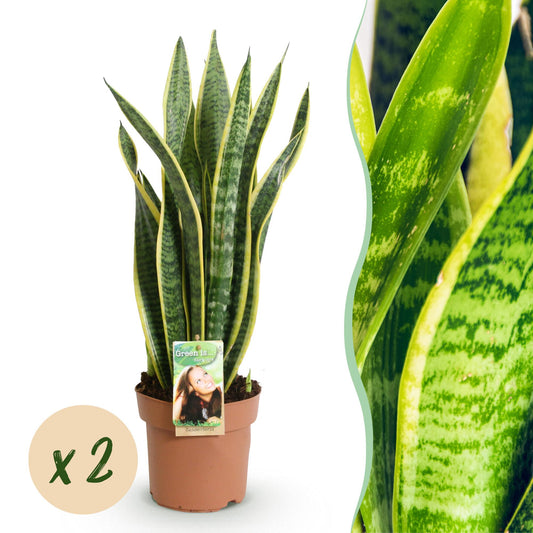
Sansevieria Laurentii - Mother-in-law's tongue - Set of 2 Plants - 17cm Pot - Height 60-70cm
Regular price From 84,95 €Regular price


✂️ Sansevieria care: watering, fertilizer, and cleaning
Watering is the only real challenge. Iowa State University Extension is clear: water only once the potting mix is completely dry, because excess water causes root rot, the main cause of death. NC State Extension recommends letting the mix dry out between waterings from spring to fall, then watering only once every one to two months in winter.
Water at the base without wetting the center of the rosette, and empty the saucer. For fertilizer, the RHS recommends feeding monthly from April to September with a liquid fertilizer for houseplants or cacti.
💧 Watering: Once the potting mix is completely dry; in winter, once every one to two months (NC State)
💧 Water: Room temperature, poured at the base, never into the rosette
🌱 Fertilizer: Once a month from April to September, diluted liquid feed
💧 Humidity: No misting or humidifier needed; it’s happy in dry air
🧹 Cleaning: Wipe dust from the leaves with a damp cloth so they can absorb light
🍂 Sansevieria care through the seasons, indoors and out
The sansevieria grows from spring through late summer. In fall, space out waterings considerably; in winter, it lives off its reserves.
The RHS recommends an ideal temperature of 15–24 °C and rates the species H1C (minimum 5–10 °C, can be placed outdoors in summer) in its RHS species profile, and 'Laurentii' H1B, which is more cold-sensitive (minimum 10–15 °C), in its RHS profile for 'Laurentii'.
NC State Extension says it tolerates cool temperatures of around 10 °C. You can therefore move it to a sheltered, partially shaded balcony in summer, then bring it back indoors as soon as the nights turn cooler.
📅 Seasonal care calendar
| Season | Key task |
|---|---|
| 🌸 Spring | Repot or divide if needed, and resume watering and monthly feeding. |
| ☀️ Summer | Water when the mix is dry, feed monthly, and move it outdoors if sheltered from rain. |
| 🍂 Fall | Bring it indoors before cool nights, reduce watering, and give the last feed in September. |
| ❄️ Winter | Water once every one to two months, don’t fertilize, and keep it away from cold drafts. |
🌱 Propagating or dividing a sansevieria
Two methods work. The quickest is division, which Penn State Extension considers the simplest: in spring, remove the clump from its pot, separate the offsets with a piece of rhizome and their roots, then repot each division. Leaf cuttings take longer.
Iowa State University Extension recommends cutting a leaf into sections about 7.5 to 10 cm long, inserting them into perlite in the direction of growth, then waiting about two months for a new plant to appear.
Note: leaf cuttings of 'Laurentii' generally lose their yellow edges, according to Iowa State University Extension and the UF IFAS production guide (University of Florida). To keep the yellow edge, divide the plant.
🐛 Common problems: causes and solutions
A sansevieria’s problems are almost always related to water or light. Here are the most common symptoms and what they mean, according to the RHS, the Missouri Botanical Garden, and NC State Extension (North Carolina State University).
| Symptom | Likely cause | Solution |
|---|---|---|
| Soft leaves, brown or foul-smelling base | 🍄 Too much water, rhizome rot | Remove from the pot, cut away soft parts, let dry, and repot in dry mix |
| Leaves bending or drooping | ☀️ Overwatering (soft base) or too little light (stretched leaves) | Let it dry, check the rhizome, and move it closer to the light |
| Wrinkled, shriveled leaves | ⚠️ Prolonged thirst, especially in summer | Water thoroughly once, then return to the normal routine |
| Pale, elongated leaves | 💧 Too much shade | Gradually move it closer to a bright window |
| Dry brown spots | ☀️ Sudden sunburn or cold against the window | Move the plant farther away; the spots won’t disappear, but they won’t spread |
| Cottony clusters or fine webbing | 🐛 Mealybugs or spider mites | Isolate the plant, clean with a cotton swab, and watch for pests on new leaves |


🌸 Our Sansevieria varieties
Most of our sansevierias are cultivars of Dracaena trifasciata; 'Mikado' belongs to a different group, and a trade name such as 'Zeylanica' doesn’t guarantee the botanical species. Find them in our Sansevieria collection. For reference, the compact 'Hahnii', described by NC State Extension as a small, funnel-shaped rosette, and the cylindrical sansevieria, now Dracaena angolensis according to the Kew profile for Sansevieria cylindrica, are other popular forms.
| Variety | What makes it special |
|---|---|
| Sansevieria 'Laurentii' | The classic snake plant: dark green, banded leaves with golden-yellow edges, awarded the RHS Award of Garden Merit. Also available as a set of 2 Sansevieria 'Laurentii'. |
| Sansevieria 'Futura Superba' | Gray-green leaves edged in yellow (NC State), on a compact silhouette, like the 'Futura' cultivar, which UF IFAS describes as having shorter, wider leaves: ideal for a table or shelf. |
| 'Zeylanica' | Compact selection sold under this trade name, in a 17 cm pot, standing 55 to 65 cm tall upon delivery. |
| 'Futura Black' | Selection sold under this trade name, in a 17 cm pot, standing 45 to 55 cm tall upon delivery. |
| 'Canary' | Selection sold under this trade name, in a 17 cm pot, standing 45 to 55 cm tall upon delivery. |
| 'Mikado' | Thin, cylindrical, stick-like leaves, sold as Sansevieria bacularis 'Mikado'; its exact botanical classification remains debated. |
🎨 Which plants pair well with sansevieria?
Sansevieria pairs well with plants that, like it, prefer dry substrate and low light. Zamioculcas is its natural partner: both need infrequent watering and tolerate shade. For a north-facing room, our guide north-facing exposure: which plants to choose will help you create a cohesive green corner.
If you're a beginner, our top 10 easy-care plants rounds out the selection. Avoid grouping it with water-loving plants in the same planter: shared watering would be fatal to it.
⚠️ Is sansevieria toxic to cats and dogs?
Yes. The ASPCA (American Society for the Prevention of Cruelty to Animals) lists Sansevieria trifasciata—that is, exactly the species covered here—as toxic to cats and dogs.
Its toxic compounds are saponins, which cause nausea, vomiting, and diarrhea. NC State Extension (North Carolina State University) rates the severity as low and adds that the sap may irritate the skin; the RHS also recommends wearing gloves when handling it.
Keep it out of reach of pets that chew on leaves and young children, and contact your veterinarian if it is ingested.
✅ Our expert tips for success
To grow sansevieria successfully, remember three rules: bright light, well-draining substrate, and watering only when everything is dry. If a plant starts to weaken, consider water first: our guide to root rot explains how to save it.
As for its benefits, let's keep things in perspective: the 1989 NASA study made it famous as an air-purifying plant, but an analysis by Bryan Cummings and Michael Waring (Drexel University, 2019) estimates that it would take 100 to 1,000 plants per square meter to match the ventilation in a home. Find more context in our article on plants said to purify the air. Choose it for its striking form and hardiness, and air out your home.
Sansevieria is the plant I give to people who are convinced they kill every plant. My only advice is to learn to do nothing: I slip a finger into the substrate, and as long as there's any trace of moisture, I don't water. To propagate a 'Laurentii', I always divide the clump rather than take a leaf cutting, specifically to preserve its yellow edging. And I put it up high when there's a cat in the house.

Laura Bruneau
Jardinière & autrice


