Stephania erecta: caring for this caudex plant and understanding its dormancy

To care for a Stephania erecta, leave most of its caudex above the potting mix, place it in bright light away from harsh direct sun, water only when the mix is completely dry, and stop watering altogether when it loses its leaves and goes dormant.
The genus Stephania belongs to the Menispermaceae family, and the plant sold under this name is primarily a storage tuber, not a bulb to be buried. It is not well documented by botanical institutions: this guide distinguishes what has been verified from what is based on observation, and gives no figures without a source.
🌿 Why Stephania erecta fascinates collectors
Stephania erecta first catches the eye with its caudex: a round, textured swelling that looks like a stone resting on the pot.
According to Plants of the World Online (POWO) from the Royal Botanic Gardens, Kew, the species it belongs to is a climbing caudex geophyte—that is, a plant that stores its reserves in a swollen organ and then develops twining stems.
It's this contrast that appeals: a tuber that remains still for part of the year, followed by slender stems that grow and bear round leaves. To see where this plant fits among other rarities, our guide to rare houseplants introduces the most sought-after groups in France.
| Feature | What it means for your home |
|---|---|
| Sculptural caudex | A round, textured tuber that remains decorative even without leaves |
| Striking growth cycle | Climbing stems that grow back from the caudex when growth resumes |
| Compact size | A plant sold in an 11 cm pot that fits on a bright shelf |
| Collector's plant | A rare species in garden centers, sold under a name that is now considered a synonym |
🔎 Stephania erecta at a glance
According to its POWO record, the name Stephania erecta Craib, published in 1922 in Kew's Bulletin of Miscellaneous Information, is a synonym: the accepted name is Stephania pierrei Diels, published in 1910. The same database places this species in Cambodia, Laos, Thailand and Vietnam, in the tropical moist biome.
It is often confused with Stephania suberosa Forman: POWO treats it as a distinct, accepted species, described in 1980 and native to an area stretching from Thailand to Cambodia, in a seasonally dry tropical biome.
Regarding the caudex itself, the University of Arkansas Cooperative Extension explains that a caudex is a short, thickened, swollen stem, and that caudiciform plants are species with this growth habit.
| Criterion | Verified details |
|---|---|
| 🏷️ Botanical name | Stephania erecta Craib, a synonym of Stephania pierrei Diels according to POWO |
| 🧬 Family | Menispermaceae |
| 🌳 Type | Climbing caudex geophyte (storage tuber and twining stems) |
| 🌍 Native range | Cambodia, Laos, Thailand, Vietnam; tropical moist biome |
| 🍃 Foliage | Light green, round leaves borne on slender stems |
| 🌸 Flowering | Not documented in our sources |
| 📏 Size | Sold in an 11 cm pot; mature dimensions not documented |
| ⚠️ Toxicity | No reliable veterinary data for this species |
📋 Quick care facts
The essential care guidelines, all in one place.
| Parameter | Guideline |
|---|---|
| Light | Bright, indirect light while in leaf |
| Watering | When the potting mix is completely dry; none during dormancy |
| Potting mix | Very well-draining mix, such as diluted cactus potting mix |
| Humidity | Normal household air; don't mist the caudex |
| Temperature | Tropical plant: protect from cold; no sourced minimum temperature |
| Repotting | Infrequently, at the start of growth, with the caudex at the same level |
| Fertilizer | Light feeding, only while in leaf |
| Toxicity | Not documented: keep out of pets' reach |
| Difficulty | Intermediate: overwatering is the real risk |
📍 Where to place a Stephania erecta: light and warmth
Place your Stephania erecta near a bright window, out of direct midday sun, which could scorch its delicate young leaves. Its stems are twining, as confirmed by POWO, which classifies it as a climbing geophyte: provide a small stake or hoop as soon as growth resumes.
No botanical institution publishes a specific minimum temperature for this species. Since its native range lies in a tropical moist biome, treat it as a tropical houseplant and keep it away from cold windows and drafts.
☀️ Ideal: Near an east- or west-facing window, in bright light without midday sun
🌥️ Acceptable: A bright room, one or two meters from a large window, though growth may be slower
🚫 Avoid: A cold windowsill in winter, drafts, and harsh sun shining through glass
🪴 Planting and repotting a Stephania erecta: keep the caudex above the soil
The key rule is never to bury the caudex: set it halfway above the potting mix, as specified on our product page, with the upper part clearly visible and dry. If buried, the tuber stays damp and becomes vulnerable to rot.
For the potting mix, the University of Arkansas recommends well-drained cactus potting mix for caudiciform plants, preferably rich in sand; adding some perlite makes the mix even lighter.
Choose a pot with drainage holes that is only slightly wider than the caudex, and repot infrequently, when the plant comes out of dormancy.
| Step | What to do |
|---|---|
| 1. Choose the right time | When the plant wakes up and new stems appear |
| 2. Choose a pot | With drainage holes, only slightly wider than the caudex, and without a decorative cachepot that traps water |
| 3. Prepare the mix | Cactus potting mix lightened with coarse sand or perlite |
| 4. Set the caudex in place | Half above the mix, with the upper part visible and dry |
| 5. Wait before watering | Let the plant settle in dry conditions for a few days, then water lightly |
columns: 4
columns_mobile: 2
-

 Sold out
-
-

 Sold out
-
-
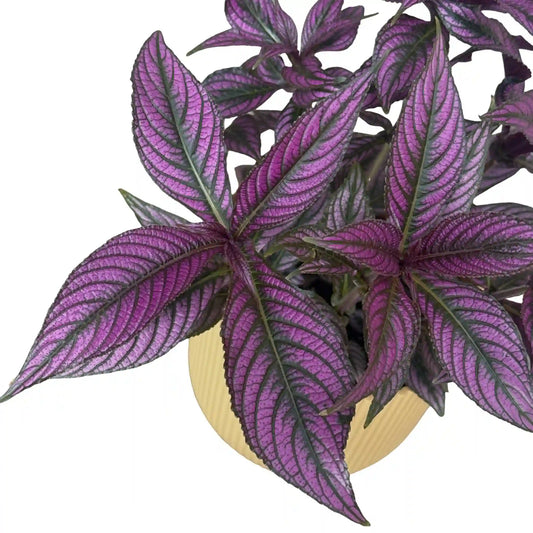
Strobilanthes Dyerianus ‘Persian Shield’
Regular price From 14,95 €Regular price39,95 €Sale price From 14,95 €Sold out





✂️ Stephania erecta care: watering and fertilizer
Caring for Stephania erecta is mainly about watering. While it is in leaf, water only when the potting mix is completely dry, pouring the water around—not onto—the caudex, then empty the saucer. We deliberately don't give a watering schedule in days: it depends on light, the pot and the season, and no reliable source specifies one for this species.
If the air is very dry while the plant is in leaf, use a tray of damp pebbles or group it with other plants instead of misting, which would unnecessarily wet the tuber. As for fertilizer, a light, diluted feed during the leafy growth phase is enough.
💧 Watering: Around the caudex, only when the potting mix is completely dry
🔹 Dormancy: Don't water while the plant has no leaves
🌱 Fertilizer: Light and diluted, only when the leaves are fully open
🪢 Support: Guide the twining stems around a hoop as they grow
👀 Check: Feel the caudex: it should stay hard and firm all year
🍂 Stephania erecta dormancy: leaf drop and regrowth
Seeing a Stephania erecta lose all its leaves can be alarming, but this is part of its normal cycle: the plant retreats into its caudex, then grows again.
For caudiciform plants in general, the University of Arkansas says that most grow during the warm summer and go dormant in winter, that many lose their leaves at this time, and recommends stopping watering, watering just once every 4 to 6 weeks if the stems start to wrinkle.
The same source cites 7 to 10°C as an ideal winter temperature, but for species from dry environments: we don't apply this guideline to a plant from a tropical moist biome. When it wakes up, resume watering gradually.
📅 Seasonal care calendar
| Season | Key task |
|---|---|
| 🌸 Spring | Stems start growing again; repot if needed; water lightly and gradually increase; add a support |
| ☀️ Summer | In leaf; bright light without midday sun; water when the mix is completely dry; light fertilizer |
| 🍂 Fall | Leaves turn yellow and drop; gradually reduce watering, then stop; stop fertilizing |
| ❄️ Winter | Dormancy: keep the caudex dry, don't fertilize, and protect from cold and drafts |
🌱 Can you propagate a Stephania erecta?
Stephania erecta isn't propagated like an ordinary foliage plant: the caudex can't be divided, and we haven't found any reliable source describing successful stem cuttings for this species. Commercial plants are generally grown from seed or imported tubers, so responsible purchasing matters: some caudices sold online may have been collected from the wild.
Ask the seller where the plant was grown. To help it settle in during its first few weeks after delivery, follow our advice on acclimating a rare plant.
🐛 Common problems: causes and solutions
The biggest danger to a Stephania erecta is overwatering, especially during dormancy, when the leafless plant uses almost no water. A softening caudex is a warning sign to watch for: our guide to root rot explains how to try to save the plant.
Like any houseplant, it can also attract pests: see our guides to mealybugs and spider mites.
| Symptom | Likely cause | Solution |
|---|---|---|
| Caudex is soft and gives way when pressed | 🍄 Rot caused by overwatering or a buried caudex | Stop watering, uncover the caudex, remove soft parts, let it dry before setting it on dry potting mix again |
| All the leaves turn yellow and fall off | ⚠️ Entering dormancy; normal cycle | Reduce watering, then stop; keep the plant warm and be patient |
| No growth after dormancy | ⚠️ Slow to wake up or damaged caudex | Feel the caudex: if firm, wait; if soft, treat it as rot |
| Caudex is wrinkled or sunken | ⚠️ Prolonged dehydration | Water lightly around the caudex without soaking the potting mix |
| Long, pale stems with widely spaced leaves | ☀️ Not enough light | Move closer to a bright window, away from midday sun |
| Cottony clusters or fine webs | 🐛 Mealybugs or spider mites | Isolate the plant, clean with a cotton ball dipped in alcohol, and treat if needed |


🌿 Our picks to explore further
To learn more about your Stephania erecta, here's the plant to bring home and our most useful guides.
| Our pick | Why choose it |
|---|---|
| Stephania erecta in an 11 cm pot | Our Stephania erecta, with its round, textured caudex, delivered in an 11 cm pot |
| guide to rare houseplants | An overview of rare plants that can be grown in apartments in France |
| choosing your first rare plant | What to consider when starting a collection of rare plants without getting discouraged |
| Beaucarnea (ponytail palm) | Another plant with a swollen base, more forgiving, for comparing care needs |
🎨 Which plants pair well with a Stephania erecta?
Stephania erecta looks right at home alongside other plants that store water.
Beaucarnea (ponytail palm) shares its swollen base and dislike of excess water, while Ceropegia woodii (string of hearts), which also forms small tubers, makes a perfect addition to a shelf devoted to caudiciform plants.
A few cacti and succulents round out the display, provided you give them the sunniest spot. To discover more rare plants, browse our Stephania and other rare plants, or explore all our indoor plants.
⚠️ Is Stephania erecta toxic to cats and dogs?
We could not find any reliable veterinary or toxicological sources on Stephania erecta or Stephania pierrei: to our knowledge, the species is not listed among the toxic and non-toxic plants on the ASPCA (American Society for the Prevention of Cruelty to Animals) website.
The Stephania genus, however, is known for its alkaloids: a publication hosted by the U.S. National Library of Medicine (PMC, NIH) describes four types of benzylisoquinoline alkaloids in Stephania yunnanensis, a plant used in traditional Chinese medicine. This does not allow us to determine how toxic our species is.
As a precaution, keep it out of reach of cats, dogs, and young children.
✅ Our expert tips for success
To grow Stephania erecta successfully, follow three key practices: keep half the caudex above the potting mix and never bury it, water only when the mix is dry deep down, and respect its dormancy by withholding water. Provide bright light without scorching sun and a small stake for its twining stems. Check its caudex regularly by touch: if it is firm, all is well; if it is soft, act promptly.
Stephania is the plant that taught me patience. The first time it lost all its leaves, I thought I had lost it; I simply stopped watering and waited, and the stems started growing again. These days, I recommend it to people who can forget about a watering can rather than those who water out of habit. And I always check the caudex with my fingertips before I start to worry.

Laura Bruneau
Jardinière & autrice