Coconut Coir for Plants: Uses and Benefits

Coco fiber is a natural, lightweight, eco-friendly growing medium made from coconut husks: it retains water while aerating roots, and is an excellent alternative to peat. The rule fits in one sentence: it makes an excellent base for a growing medium, mixed with perlite and supplemented with fertilizer, since it is low in nutrients. Find what you need to create your own mixes in our range of growing media.
This guide explains what coco fiber is, its benefits, the different forms it comes in, how to use it, and why it is winning over more and more environmentally conscious gardeners.
🌿 What is coco fiber?
Coco fiber, or coir, is a natural material made from coconut husks (the outer husk). It is a byproduct of the coconut industry, processed into a lightweight, porous growing medium.
As Oregon State University Extension explains, when coconuts are harvested and husked, the long fibers are used for various purposes (ropes, brushes, doormats), while the short fibers, once considered waste, have found a horticultural use as “coco peat.” Its use even helps address a waste problem in producing countries.
Most coco fiber comes from Sri Lanka and India. Its texture resembles peat, but it is darker in color and differs in one major respect: it is renewable.
✅ The benefits of coco fiber
Coco fiber has several qualities that make it an excellent component in growing media: high water retention, good aeration, neutral pH, and renewability. This balance is what makes it so popular.
Its water-holding capacity is remarkable: it can absorb up to about ten times its weight in water while retaining nearly 20% air to let roots breathe. Its neutral pH, unlike naturally acidic peat, makes nutrient management easier. It lightens heavy growing media, helps prevent compaction, and can often be rinsed and reused. It is also reputed to deter some pests such as fungus gnats and resist certain diseases, making it a healthier medium than many conventional potting mixes for sensitive plants.
| Benefit | Benefit for the plant |
|---|---|
| Water retention | Up to ~10 times its weight |
| Aeration | Roots can breathe, less compaction |
| Neutral pH | Easier nutrient management |
| Renewable | Eco-friendly alternative to peat |
Coco fiber has changed the way I put together growing media. I love how eco-friendly and lightweight it is, but I always remind my customers of two things: it doesn’t provide nutrients, so you need to fertilize, and it’s best to mix it with perlite to keep the roots from getting waterlogged. Used on its own and soaked through, it can suffocate roots. In the right proportions, it’s a wonderful base. After years of using it, it has become one of my favorite ingredients.
🪴 The different forms of coco fiber
Coco fiber comes in three forms, each with complementary properties: fiber, coco peat (pith), and chips. Knowing the differences helps you choose the right one for your needs.
Fiber itself, in strands, mainly provides aeration. Coco peat, finely ground (1–3 mm particles), resembles peat and retains a lot of water, but can suffocate roots if used on its own. Chips, in small pieces, combine water retention with air pockets. Many products blend these forms to achieve an optimal balance.
columns: 4
columns_mobile: 2
-
Hoya Premium Potting Soil - Enriched with Mycorrhizae and Bacillus - Made in France
Regular price 11,99 €Regular price11,99 €Sale price 11,99 €11,99 €9,60 € -
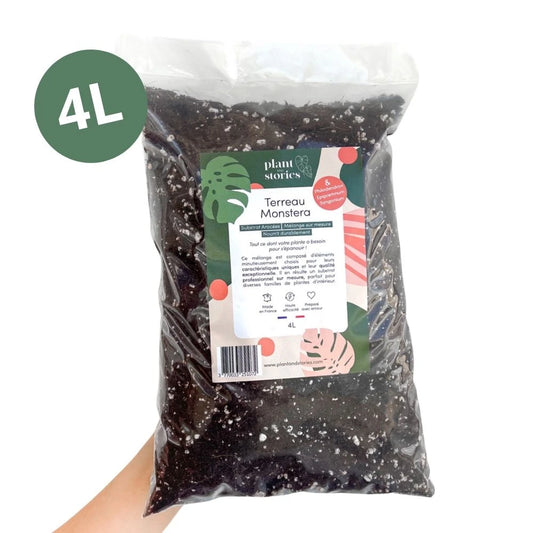
Monstera Soil - Enriched with Mycorrhiza and Bacillus - Araceae Substrate
Regular price From 9,50 €Regular price23,75 €Sale price From 9,50 €9,50 €From 7,60 €Sale -
Premium Anthurium Potting Mix - Enriched with Mycorrhizae and Bacillus - Made in France
Regular price 11,99 €Regular price11,99 €Sale price 11,99 €11,99 €9,60 € -
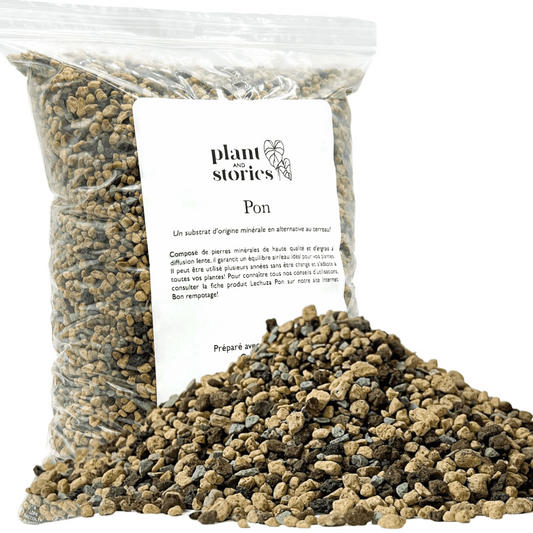
Pon - Hydroponic mineral substrate for plants - Hydroponic plant cultivation
Regular price From 6,50 €Regular price6,50 €Sale price From 6,50 €6,50 €From 5,20 € -
Duo - Universal Substrate 10L + Universal Liquid Fertilizer 250ml + free graduated pipette
Regular price 32,00 €Regular price37,00 €Sale price 32,00 €32,00 €25,60 €Sale





| Form | Main property |
|---|---|
| Fiber | Aeration; decomposes over time |
| Coco peat (pith) | High water retention |
| Chips | Water/air balance |
| Blend | The best of all three |
| Typical coco mix | Suggested proportions |
|---|---|
| All-purpose growing medium | Coco + perlite (approx. 70/30) |
| Aroid mix | Coco + perlite + bark |
| Seeds / cuttings | Fine coco, a little perlite |
🪜 How do you use coco fiber?
Coco fiber is rarely used on its own: it is mixed with other components to create a balanced growing medium. The most common base combines 30 to 50% coco, perlite, and optionally bark.
It often comes in compressed bricks that need rehydrating: soak it in water, and it swells and loosens, ready to use. Then mix it with perlite for drainage, and add fertilizer, since coco provides no nutrients. It is suitable for repotting, sowing seeds, propagating cuttings, and soilless growing.
🌵 Which plants and uses is it suited to?
Coco fiber is suitable for a wide range of plants and growing methods, from seed starting to soilless cultivation. Its versatility is one of its major advantages.
It works especially well for aroids, tropical plants, and cuttings, which benefit from an airy, moist growing medium. Mixed with perlite and bark, it makes an excellent “aroid” base. It is also used as a hydroponic growing medium, as a liner for hanging baskets, and to boost water retention in overly fast-draining mixes. For cacti and succulents, use it only in small amounts, as it holds more water than they like.
| Use | Why use coco? |
|---|---|
| Repotting aroids/tropical plants | Ideal airy, moist base |
| Seeds and cuttings | Gentle, clean, uniform medium |
| Hydroponics | Conventional soilless growing medium |
| Cacti / succulents | Use only in small amounts |
⚠️ The limitations of coco fiber
Despite its advantages, coco fiber has limitations you need to know about to use it properly. The main one is its low nutrient content.
Unlike enriched potting mix, coco provides almost no nutrients: without fertilizer after 4 to 6 weeks, plants will eventually turn yellow. It may also contain residual salts if it has not been rinsed properly, and its water retention is not always uniform: the top of the pot may seem dry while the bottom remains damp, so it is important to check deeper down before watering. If managed well, none of these limitations is a deal-breaker.
📋 Quick reference (for experienced gardeners)
Key facts about coco fiber at a glance.
| Parameter | Reference |
|---|---|
| Origin | Coconut husks (Sri Lanka, India) |
| Water retention | Up to ~10 times its weight |
| pH | Neutral (vs. acidic peat) |
| Forms | Fiber, pith, chips |
| Nutrients | Low: fertilizer needed |
| Mix with | Perlite, bark |
| Precaution | Choose rinsed coco (salts) |
| Eco benefit | Renewable, alternative to peat |
⚖️ Coco fiber or peat: which should you choose?
Coco fiber is increasingly preferred over peat, especially for environmental reasons. Peat takes centuries to form, whereas coco is a renewable byproduct.
According to Clemson University (HGIC), coco is one of the few options on the market for those who want to avoid peat, especially for seed starting, with a similar look and feel. For growing, coco has a neutral pH that is easier to manage, while peat is acidic. Peat is still cheaper in some places, though. From an environmental perspective, peat extraction destroys valuable ecosystems, leading many gardeners to choose coco.
| Criteria | Coco fiber | Peat |
|---|---|---|
| Renewable | Yes | No (very slow to form) |
| pH | Neutral | Acidic |
| Environmental impact | Low | Destruction of peatlands |
| Reusable | Often | Rarely |


🩺 Troubleshooting: using coco fiber effectively
A few common mistakes can limit the effectiveness of coco fiber. Here’s how to avoid them.
| Problem | Cause and solution |
|---|---|
| Suffocated roots | Soaked coco on its own: add perlite |
| Yellowing plant | Nutrient deficiency: fertilize |
| Scorched leaves | Residual salts: choose rinsed coco |
| Hardened growing medium | Dried-out coco: rehydrate it; don’t let it dry out |
To put together your own mixes, our range of potting mixes and growing media and our horticultural perlite help you create the ideal environment.
💚 Sustainable growing media with Plant and Stories
Coco fiber is a growing medium for the future: eco-friendly, lightweight, and versatile, it provides an excellent water/air balance when supplemented with fertilizer and mixed with perlite. It is a healthy base for vigorous roots.
To create your own growing media, explore our potting mixes and growing media and soil amendments, carefully selected in France. Eco-friendly and effective, coco fiber deserves a place in every plant lover’s cupboard if they care about their environmental impact.